Culture and Society
 PUBLISHED
 1
1


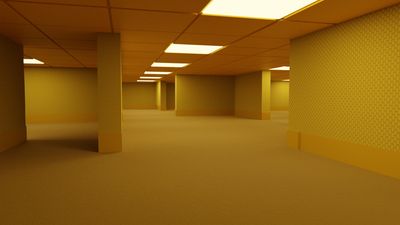


If you've spent any time wandering around the internet over the past few years, there’s a good chance you will have come across the viral trend of "liminal spaces", images of environments that are faintly surreal, melancholic, weirdly familiar, and often very creepy.
That once-niche internet aesthetic has now gone thoroughly mainstream with Backrooms, an A24 movie in which a struggling furniture store owner and his therapist discover an endless, unsettling labyrinth of liminal rooms in the store's basement.
What is a liminal space?
There is no strict definition of what is and what isn't a liminal space, but you know it when you see it. Common themes are stretching corridors, eerily lit rooms, and unsettlingly open spaces. Whatever it is, essentially none of the images feature any people or living beings, although subtle signs of their presence may be there.
On the Liminal Space subreddit, one of the hives of this loose-knit online culture, there’s a quote that reads: "A liminal space is the time between the 'what was' and the 'next.' It is a place of transition, waiting, and not knowing. Liminal space is where all transformation takes place, if we learn to wait and let it form us."
.jpg "The original \"Backrooms\" image was posted on 4chan in 2011. In 2024, it was ourced to a real furniture store in Wisconsin.")
That bit of text closely ties to the definition of “liminality,” a term used in anthropology to describe the ambiguity or disorientation we sense in a state of transition between one stage and the next. This is perhaps why so many of the liminal spaces we see are areas that we experience in the transitions of our everyday lives: corridors, waiting rooms, and open roads.
Nostalgia also appears to play a role in the images. If you take a quick scan through a bunch of the liminal spaces that have been shared, you'll see they often involve aesthetics from the 1980s and 90s, a time that now only feels faintly familiar to the millennial and Gen-Z internet users who grew up in these decades.
Why are liminal spaces creepy?
Two common sensations associated with viewing liminal spaces are familiarity and creepiness. While the images are often visually beautiful and interesting to look at, they can be quietly unsettling.
In 2022, two psychologists from Cardiff University in Wales looked into the phenomenon of liminal spaces and found that the uneasiness we feel is essentially the uncanny valley effect.
The uncanny valley is the reason why we can find dolls, puppets, clowns, and super-realistic robots a bit creepy.
It is the idea of something being very predictable but simultaneously deeply unfamiliar, resulting in a feeling of revulsion. While we are attracted by the familiar feature, such as a smile, we are repulsed by the unfamiliar, such as the dead eyes of a doll, causing a contradictory and unsettling feeling of cognitive dissonance.
The uncanny valley hypothesis is typically associated with humans or human-like entities, but the researchers from Cardiff University explored whether an uncanny valley effect can be found in built environments too.
They showed dozens of their students over 100 different images of physical spaces, some real or artificial, that had been previously defined as liminal space, eerie, or ambiguous. They also noted a number of features from the images: feature displacement, lack of features, lighting, occlusion, repetition of features, type (e.g., hallway), and unusual sizes.
After viewing the images, the participants were asked about their own sensibilities and how they felt toward the images.
In sum, the sense of uncanniness resulted from deviations from familiar patterns. In other words, the physical spaces are deeply relatable and familiar – a repeating hotel corridor, an empty airport, a dingy basement – but the images feature something that is also unfamiliar – the lighting is “off,” there's an absence of people in a public space, the proportions feel unreal.
“Uncanniness is a general reaction to deviations from familiar patterns,” the study authors conclude.
As a result, these contradictory feelings sit uneasily inside us and evoke that well-known feeling of being creeped out.
Why Backrooms works as a horror film
All of this explains why the film Backrooms works as a psychological horror movie. Chiwetel Ejiofor, who stars in the film, told Fangoria that he believes its appeal lies in how it expresses "something that has always kind of been there, but you haven't been able to fully articulate."
In other words, it feels deeply familiar yet vividly unrecognizable all at once – like an unnerving dream you can't quite put your finger on.
The director, YouTuber-turned-filmmaker Kane Parsons, went even further, describing the movie as “cosmic horror.”
“With ‘Backrooms,’ I take it in the science fiction direction,” he said in slightly rambling interview with Variety, "but it’s a tangible version of that idea and exploration in the form of this place that is either exploiting or using, probably not consciously, but I think people find it and come into contact with it, and they find that most of the horrors to be found are them projecting their own interior world onto it, like a person in sensory deprivation, grasping at random noises, using what’s in their own mind subconsciously to try to make sense of it.”
An earlier version of this story was published in November 2022.