Culture and Society
 PUBLISHED


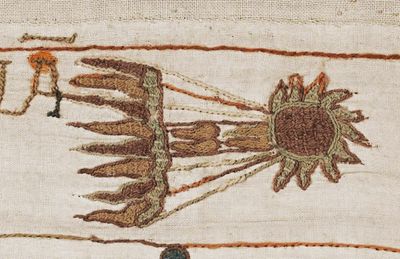


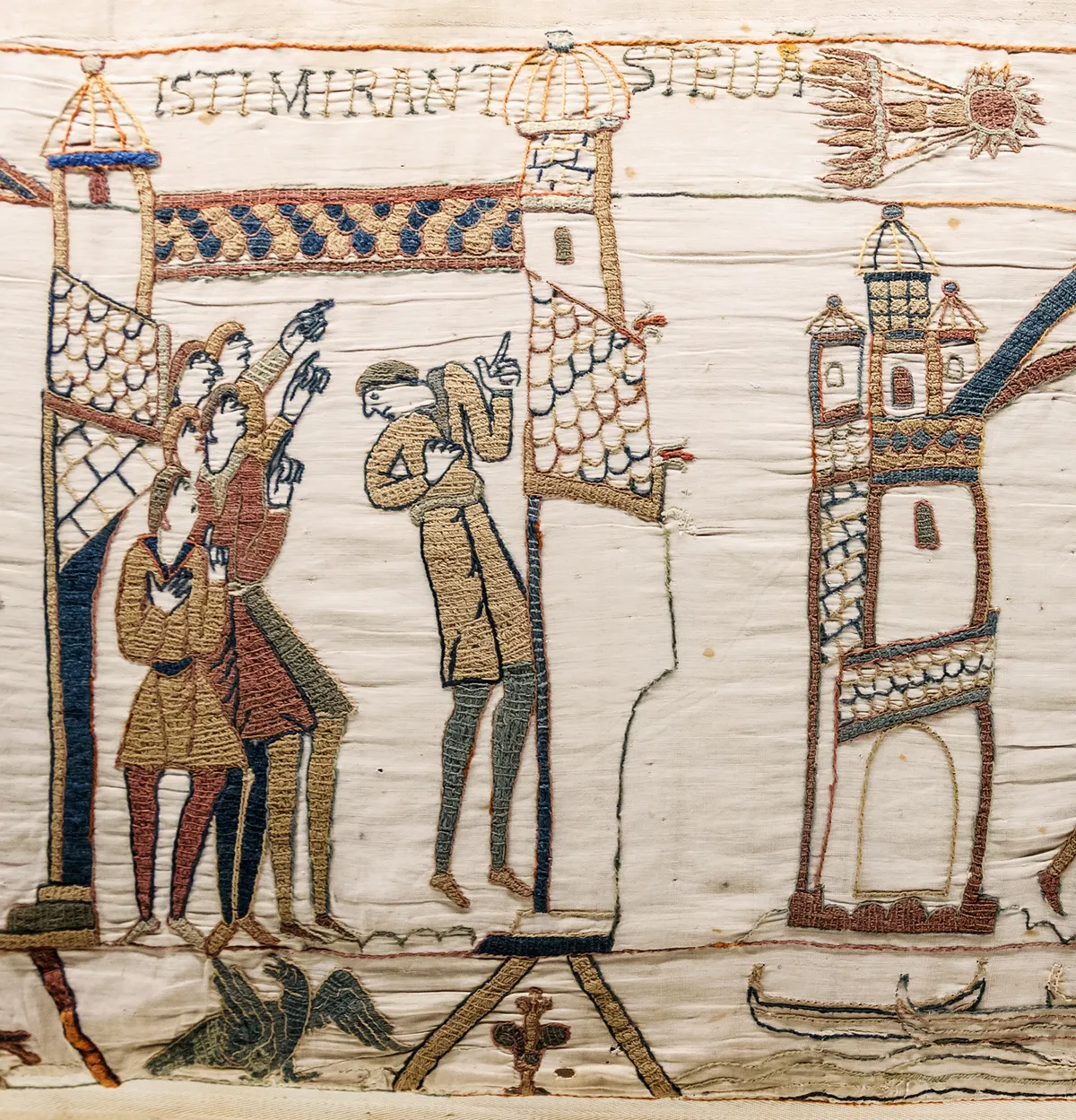
The Bayeux Tapestry is one of the most famous textile works in the world, and for the first time in more than 900 years it has returned to England to be exhibited at the British Museum. The work of art depicts the events leading up to the Battle of Hastings of 1066 and the Norman conquest of England. It also depicts an important astronomical event, the return of Halley’s comet. Although not in the right place.
First of all, despite being the Bayeux Tapestry, it is actually an embroidery. A tapestry has the design woven into the fabric, while embroidery involves stitching it on. Despite the confusion, the work is one of the most impressive in the world. It is 68.3 meters (224 feet) long and originally 50 centimeters (19.7 inches) wide (though it now varies due to supporting cloth added later).
Blame it on the comet!
Comets have often been seen as a bad sign, an indication that something changing in the heavens might mean that something must be about to change on Earth too. Today we know that change is constantly happening, but in the past, the sky was seen as eternal and immutable. The presence of a comet was a challenge to that deeply held belief.
And that’s the symbolic meaning that Halley’s comet takes on in the Bayeux Tapestry. It appears soon after Harold became king in January 1066. The news is brought to the monarch, who then sees a ghostly fleet, a premonition of the Norman invasion that would take place later that year.
Even if we assume that the power of suggestion is such that hearing of a comet, King Harold immediately believes that he is in danger, there is an issue with this tale. Halley’s comet was not yet visible in January. It was only seen in late April.
A constant celestial companion to humanity
“Halley's Comet is the only short-period comet that is easily visible from Earth with the naked eye. Its solar orbit time of 75-76 years makes it possible to see twice in a human lifetime. As a result, it is the most observed comet in human history, appearing in every major historical era,” Jake Foster, an astronomer at the Royal Observatory Greenwich, previously told IFLScience.
“Its depiction in the Bayeux Tapestry after appearing overhead during the Battle of Hastings in 1066 is one such example.”
The comet has been seen truly since the dawn of our species, with reports of its presence in the sky across history and across cultures. It takes its name from Edmond Halley, who would go on to be Astronomer Royal, and who was able to work out that the comet of 1682 had been near the center of the Solar System before.
It turned out that he might not have been the first to make this connection about the comet. A monk called Aethelmaer might have connected two passages of Halley to the same object. Still, he did not have the mathematical knowhow that would lead to the understanding of what comets really are.
“Halley's research included studying the astronomical records of two dozen comet sightings that occurred between the 14th and 17th centuries, examining their noted paths across the sky. Three of these sightings were found to have matching orbital patterns – factors such as reaching the same closest distance to the Sun (known as perihelion) and doing so from the same angle,” Foster told IFLScience.
“These sightings happened in 1531, 1607, and 1682, indicating an orbit time of 75-76 years. Halley even noticed that the comet was pulled on by the gravitational forces of Jupiter and Saturn when it got close to them, so he added this into his calculations to make his prediction even more precise. Halley first saw the comet with his own eyes in 1682 when he was 25 years old. He correctly predicted that it would return in 1758 but didn't live to see its return, dying in 1742 at the age of 85.”
Across science and art, the quintessential comet
Halley did not live long enough to see its namesake comet come back around, but his prediction was confirmed by Johann Georg Palitzsch, who was the first person to see the comet in 1758 on a cold Christmas Day.
And Christmas has a particular connection to the comet. The depiction of The Star of Bethlehem, the celestial sign that Jesus was born under according to one gospel, is usually pictured as a comet. And the inspiration is not just any comet, but Halley’s itself.
We can credit Giotto di Bondone's extraordinary 1305 fresco, The Adoration of the Magi, for this connection. The Christmas star is inspired by the Italian artist's own observation of Halley’s Comet during its 1301 passage.

For this reason, the first space mission to comets, the European Space Agency's Giotto probe, was named after the artist. ESA’s Giotto was also the first deep space mission for the agency, and it encountered comets Halley and Grigg–Skjellerup. Its close encounter with Halley’s comet delivered the closest views yet of a cometary nucleus.
The last time Halley’s comet was around us, it was 1986, and it was the worst view that humanity had had of the comet in 2,000 years. We can be certain that in 2061, we will get a much better spectacle.