Space and Physics
 PUBLISHED
 1
1


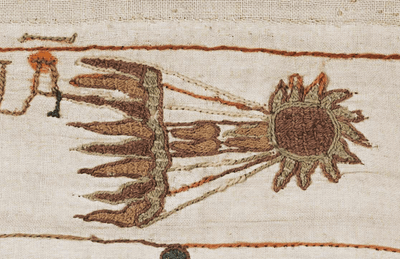


Halley’s Comet will not return for another 35 years, but that doesn’t mean it’s out of the news. This week, a media release on new research, headlined “Halley’s Comet Wrongly Named,” had several outlets jump on board. We thought it raised some interesting questions, both about the famous comet and more broadly. In particular, if a cosmic object has been named in error, should that be corrected, and how likely is that to happen?
Was Halley The First?
The release in question is based on a book chapter in which Professor Michael Lewis of the British Museum and Professor Simon Zwart of Leiden University present evidence that the monk Eilmer of Malmesbury recognized the cyclic nature of the comet we now call Halley’s six centuries before Halley did, and therefore is deserving of the name.
Eilmer, or Aethelmaer as he is sometimes called, certainly seems to have been an interesting character. He is reported to have attached wings to his arms and legs, long before the Wright Brothers, to fly a distance of 200 meters (660 feet), although the landing broke his legs.
Nevertheless, Eilmer’s understanding of the comet was almost certainly far below Halley’s. Halley was following in the footsteps of Johannes Kepler, who had shown it was possible to calculate the orbits of planets from observations using three laws he devised, which Newton later developed further. Halley used observations of comets from the years 1531, 1607, and 1682 to show they were actually the same object and calculate its orbit, thus proving periodic comets existed and their returns could be predicted. His successful prediction of its return in 1758 was based not just on noting the comet seemed to turn up every 74.7 years, but on being able to work out its movements in between.
.png "A representation of Halley's comet in 1682, the year he observed it and took observations he subsequently used to establish its orbit.")
It would have been almost impossible for Eilmer to do anything similar. He wasn’t just working without the insights of Kepler, but those of Copernicus; if he understood the comet as orbiting anything, he would have thought it was the Earth, rather than the Sun.
We don’t know exactly what Eilmer did grasp, since his writing (and wings) have been lost. All we have is the record of his activities by William of Malmesbury. Although William is considered a reliable historian by medieval standards, and was a monk in the same abbey, he was also writing about 50 years after Eilmer died. His accounts would have been second-hand at best.
To the extent we can rely on William’s account, Eilmer was more interested in what he thought the comet’s return in 1066 meant for English politics (nothing good) than its movement. “You’ve come, have you?” William quotes his predecessor as saying. “You source of tears to many mothers. It is long since I saw you; but as I see you now, you are much more terrible, for I see you brandishing the downfall of my mother-country.”
We don’t know whether Eilmer really identified enough commonalities between the comet he had seen in 989 and the one that watched over King Harold’s demise, as depicted in the Bayeux Tapestry, to make a convincing case of the connection. Perhaps, he just thought the two brightest comets of his life must be connected and got lucky.
Jumping to conclusions is not the same thing as evidence that can survive peer review, even if it turns out to be right.
How Do Comets Get Their Names?
Today, comets are named after the first people, or organization, that detects them and recognizes they’re seeing a comet (not a smudge on an eyepiece) that is not an already known object. To do the last part of that, the orbit needs to be calculated, at least approximately, so the return of a previously known object can be ruled out.
To establish priority, reports need to be made to the Central Bureau of Astronomical Telegrams. The fact that someone calculated the comet’s orbit earlier, but didn’t report it properly, isn’t going to see a comet renamed. What Halley did looks far more like what is required for naming rights than the most positive interpretation of Eilmer’s achievement.
Encke’s Precedent
One of the most famous dirty snowballs after Halley’s is known as Encke’s Comet. It never gets remotely as bright as Halley’s – which is the only known periodic comet that is consistently visible to the naked eye – but partially makes up for that by having just 3.3 years between each closest approach to the Sun. Johann Encke calculated its orbit in 1819 based on observations made the year before and successfully predicted its return in 1822.
Enke’s role in this was comparable to Halley's. Many people had spotted the comet before – the first two reports being by Pierre Mechain and Charles Messier in 1786. Although not sighted a few times when Earth was badly positioned, the comet had been seen on at least three orbits before Jean-Louis Pons spotted it in 1818.
Pons noticed enough similarity to the movements of the 1805 appearance to suspect this was the same comet. Rather than putting his name on it, Pons passed the idea on to Encke, who did the hard number-crunching, and achieved fame as a result, showing this was also the comet seen in 1786 and 1795.
Still, Pons’ place in the history books is secure. Having discovered 37 comets, a record unlikely to ever be broken by a person, now most comets are seen first by programs, his name is attached to three of them, including the recently devilish Pons-Brooks.
Pons' contribution here certainly seems greater than Eilmer’s. If a fourth comet does not get named after him, it’s hard to see why Eilmer should get to displace Halley.
Naming Principles
Most other astronomical objects don’t bear the name of whoever found them. For example, asteroids are initially given a name based on the year of discovery and their order in that year. Only much later will a name be allocated, and it’s to honor someone the astronomical community thinks deserving, not the discoverer.
Although there are a few stars named after someone who noticed something significant about them, such as our neighbor, Barnard’s Star, these are very much the exception and are frequently informal. A strong argument has been put forward that the galaxies known as the Magellanic Clouds shouldn’t bear the name of a slave trafficker and mass murderer, but so far, it’s still what they get called.
A better comparison with comets might be scientific theorems or equations. In addition to Kepler’s three laws referred to above, we also talk about the Doppler Effect, Archimedes Principle, and Leidenfrost Effect, among many others.
In some of these cases, priority is in dispute. Before databases of scientific papers were a global phenomenon, it was easy for people to publish something that went unnoticed, only for someone else to later get credit, whether plagiarism occurred or not. Such events were particularly likely if the first person to notice the phenomenon was not the sort to be taken seriously by the men who dominated science at the time.
However, once a name is in widespread use, it seldom gets changed even if some people grumble that someone else has a better claim. A mathematical method for evaluating limits is widely known as l'Hôpital's rule, reflecting Guillaume de l'Hôpital's publication of it in a 1696 book.
It is believed, however, that the discovery was made by Johann Bernoulli. In an early example of oppressive intellectual property, l'Hôpital had employed Bernoulli on terms that included having the right to use any discoveries Bernoulli made. L’Hôpital later acknowledged Bernoulli and his brother had made many of the discoveries he included in his book, but the name stuck.
Then again, considering the staggering array of achievements members of the Bernoulli family are remembered for, having the rule might be confused with his son’s principle.
At most, in such circumstances, an extra name will be added. Officially, Hubble’s Law is now known as the Hubble-Lemaître Law after an International Astronomical Union decision, but most people continue to use Hubble’s name alone.
There is, however, one area of science where renaming is becoming common: species, particularly birds. Many animals have been named after an individual, often the first scientist to describe them, but organizations like the American Ornithological Society are changing that. These aren’t the Latin scientific names, but popular ones.
However, instead of changing the name to some scientist who got there first, the new names are descriptive or reflect what indigenous peoples in the species’ range call them. "Names have power and power can be for the good or it can be for the bad," Colleen Handel, the American Ornithological Society's president, told NPR. "We want these names to be powerful in a really good way."
Yet to get there took an extensive campaign reflecting the fact that all too often, the common name of a species was either explicitly racist or honored someone as violent as Magellan, without similar accomplishments.
Edmond Halley, on the other hand, is looked on with considerably more favor. Not only a great scientist in his own right, Halley soothed conflict between some of the less personable scientists of his day, without which Newton’s Principia might never have been published. It’s unlikely someone like that will lose naming rights to their comet.