Nature
 PUBLISHED
 1
1


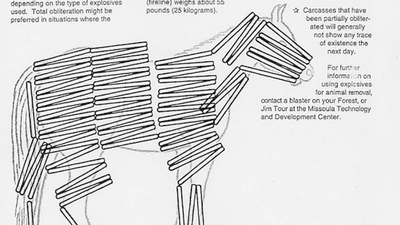


The United States Forest Service (USFS) has a handy guide, complete with illustrations, on how to blow up a horse. If you've ever heard the tale of a certain Oregon whale that was splattered across a crowd of onlookers and journalists, you probably already realize this isn't a terrible idea.
The guide – first published in 1995 for use by USFS employees – explains that sometimes you just have to blow up a horse. Dead animals in recreation areas, for example, can attract bears, which could lead to a situation with even more carcasses to dispose of.
Though moving the bodies of dead animals is preferable, the guide suggests that sometimes it is necessary to use explosives to get the job done, say in remote areas or hard-to-access places where removal of the animal is not possible. In these circumstances, you'd better reach for your official copy of "Obliterating Animal Carcasses With Explosives".

When urgency is not a factor, they recommend that "dispersion" – a nice way of saying "scattering parts of the corpse, rather than obliterating it" – can be acceptable. In these circumstances, USFS employees are recommended to "place 1 pound [0.45 kilograms] of explosives in two locations on each leg", as well as quite a few larger explosives underneath the main body and head. Before you detonate, employees are advised to remove the horseshoes, decreasing the chance of flying metal debris and increasing the odds of any other debris being horse.
In cases where it's not possible to get explosives underneath the carcass, they recommend laying a hell of a lot more explosives on top of the horse.

Though the guide's authors state that "carcasses that have been dispersed will generally be totally gone within a few days" and that corpses that have been "partially obliterated will generally not show any trace of existence the next day", they advise that if there is real urgency, sometimes complete obliteration is necessary.
"Most large animal carcasses can be adequately disbursed with 20 pounds (9 kilograms) [of] explosives," they write. "However, 40 to 55 pounds (18 to 25 kilograms) are recommended to ensure total obliteration."
Trust us, this is not something you want to get wrong.
An earlier version of this article was published in August 2022.