Space and Physics
 PUBLISHED


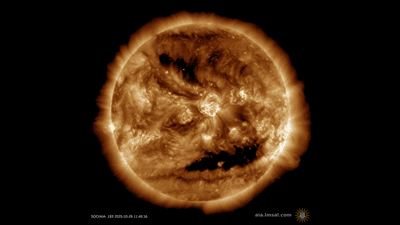


Humans love a spot of pareidolia, our ability to see faces in things that do not have faces. But the Sun is definitely looking like a face, these days, right? Like, it’s got a big scary mouth, a large right eye, and it is definitely looking to its left. We are certain that even our star is getting into the spirit of Halloween.
Fine, it’s not a face! It’s just a mixture of active regions on the surface of the Sun and a massive coronal hole, as seen in the extreme ultraviolet by NASA's Solar Dynamics Observatory (SDO) today.
Sunspots are areas on the sun with cooler temperatures compared to the surrounding region, and in visible light, they appear as dark splotches on the surface of our star. They do not look like that in ultraviolet light. Sunspots also have strong magnetic fields coming in and out of them, and those fields move hot plasma, which can be seen in its bright dynamics at more energetic wavelengths of light.
The coronal hole, which makes the mouth of our imagined face, is quite the opposite. It is a lack of trapped plasma in the atmosphere of the Sun, the solar corona, over the area that creates the hole. The corona is millions of degrees hot, and the hole tends to be cooler than the surrounding areas.
The culprit is once again the magnetic field of the Sun. Instead of field lines extending out from the Sun and then back into it, like in sunspots or the beautiful prominences, a coronal hole has open unipolar field lines. This means that the magnetic field is just pointing outwards.
This has an important effect: it allows the solar wind – the stream of charged particles escaping the Sun – to escape more easily. Thanks to the increase in solar wind streaming out, coronal holes lead to an increase in auroral activity. It is not surprising that forecasts suggest bright aurorae at high latitudes over the next few days!
.jpg "Another image of the sun with a heart shaped coronal hole near the middle of the solar disk.")
Coronal holes are fairly common; just last month, the Sun had one that looked like a heart or a bird.