Nature
 PUBLISHED


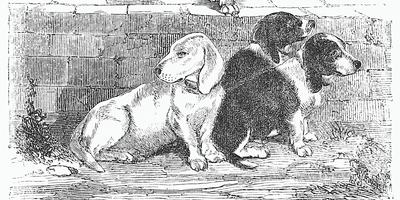


Dogs may be humans’ best friends, but they’re also kind of our greatest invention. From hunters to trackers, from guards to guides, we’ve honed, bred, and trained the once-noble wolf into any number of specialist workers – pets, sure, but helpers first.
We have, in other words, made them indispensable. But their usefulness comes with a flipside: once we no longer need a breed’s particular talents, there’s no real reason to keep them around any longer. Such was the fate of the turnspit dog: a small, stumpy dog whose home was at the hearth.
A dog’s life
We don’t know exactly when the first dog was put to work in a kitchen, but it must have been before 1570. That’s when John Caius’s De Canibus Britannicis – “On British Dogs” – was published, describing for the first time a type of dog which, “when any meate is to bee roasted[,] they go into a wheele which they turning rounde about with the waight of their bodies, so diligently looke to their businesse, that no drudge nor skullion can doe the feate more cunningly.”
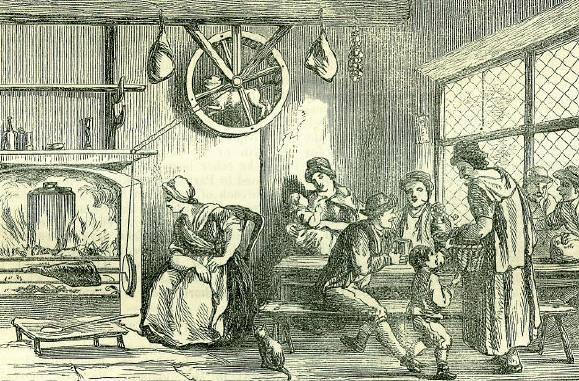
Their job was simple: day in, day out, they would trot away inside of a wall-mounted wheel, powering the turning of a spit with their movement. It was a miserable life, even by the standards of a Tudor-age working dog: “Turnspit dogs were viewed as kitchen utensils, as pieces of machinery rather than as dogs,” Jan Bondeson, author of Amazing Dogs, a Cabinet of Canine Curiosities, told NPR back in 2014.
If the dog slowed or stopped for a break, it could expect hot coals to be thrown into the wheel with it, Bondeson explained; the little guys were scolded and beaten, worked non-stop for hours on end; even on their one day off a week, they were put to use as foot warmers in church.
They weren’t even allowed to keep their tails: in The Comedy of Errors, Shakespeare references them as being “curtailed”. That “means they've got their tails cut off,” Sally Davis, of the Abergavenny Museum where the last surviving specimen of a turnspit dog – a taxidermized pup named Whiskey – is kept, told NPR. “It was a way they used to differentiate between the dogs of the nobility and the dogs belonging to ordinary people. These little curtailed mongrels were the ones put into the wheels.”
And here’s the thing: even in these less animal-friendly times, their mistreatment was no secret. The dogs were known for having gloomy dispositions, and that was often directly attributed to how rough their lives were. There’s even a story, recorded by natural historian Edward Jesse in his somewhat colorful 1846 book Anecdotes of Dogs, where the turnspits in the city of Bath “hear[d] one day the word ‘spit,’ which occurred in the lesson for the day” during a church service – “they all ran out of the church in the greatest hurry,” author Edward Jesse wrote, “evidently associating the word with the task they had to perform.”
Life at the wheel
Pretty quickly, turnspit dogs became an essential part of any large kitchen. “During the Middle Ages, cooking a meal, large joint meat could only be done on a spit, and the lowliest person in the kitchen staff, usually a small boy, turned the spit hours and hours,” explained Davis on an episode of NPR's Hidden Kitchens series.
“The hands used to blister,” she said – so, like werewolves at sunset, “during the 16th century they made the transition from small boys to dogs.”
The pitter-patter of the dogs’ little feet at the wheel was, for a long time, just another feature of the kitchen – part and parcel with the smoke and heat and wretched smells. And as the turnspits proved themselves useful, their use spread: while primarily known as a British dog these days, there are records of turnspits being used in Germany and France, and they even made it over the Atlantic to the New World.
“The Statehouse Inn was where all the old political cronies hung out for their slice of beef and their ale,” noted author and food historian William Woys Weaver. “The owner, in 1745, advertised spit dogs for sale. Evidently he was also breeding them.”
“In 1702, the wife of William Penn, founder of Pennsylvania, writes to England that she wants a wheel for her turnspit dogs and a butter churn,” Weaver added. And “in this country the dogs were basically used turning spit in large establishments in cities, like hotel kitchens.”
What kind of dog is that?
Now, we know what you’re thinking: exactly what breed was this turnspit? What did it look like? And the truth is, we don’t really know – not just because they no longer exist, but because they kind of predate the whole “breed” idea entirely.
“For most of history what dogs did counted more than [how they] looked,” explained Michael Worboys, emeritus professor in the University of Manchester’s Centre for the History of Science and author of The Invention of the Modern Dog, in 2019. “The types of dogs that existed were bred to do particular tasks, like to collect game that had been shot or to protect sheep from wolves.”
Any turnspit, therefore, was probably a bit of a mutt. They had short, crooked legs and a big, heavy head; their fur was usually “bluish grey, spotted with black,” according to Jesse, but could just as easily be black or reddish brown. They had curly tails and floppy ears; interestingly, they would “generally have the iris of one eye black and the other white,” Jesse noted.
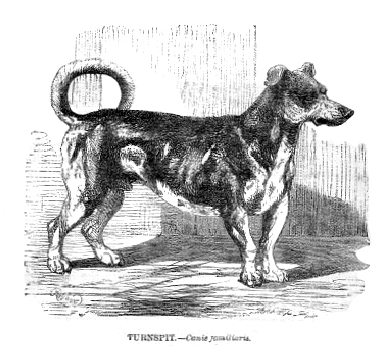
But none of those features would have been a given. It wasn’t until the Victorian era that “breeds” were standardized and cataloged – and by that point, turnspits were well on their way to extinction. It had become “a stigma of poverty to have a turnspit dog,” Bondeson said. “They were ugly little dogs with a quite morose disposition, so nobody wanted to keep them as pets.”
The downward dog
With the dawn of the Industrial Age, the turnspits’ days were numbered – which, by all accounts, they were probably pretty grateful for. The invention of mechanical spit-turners meant the little dogs no longer had a place in the kitchen, and their numbers plummeted: by 1807, they were almost completely extinct, and by 1900, they were gone for good.
But as miserable and unappreciated as their lives were, they still left a legacy – even if it is a bittersweet one.
“In the 1850s, the founder of the SPCA [Society for the Protection of Animals] was appalled by the way the turnspit dogs were treated in the hotels in Manhattan,” Weaver told NPR. “This bad treatment of dogs eventually led to the founding of the SPCA.”