Nature
 PUBLISHED
 3
3


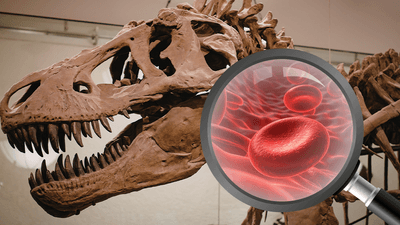


In 1990, a thought experiment hit bookstores: could science resurrect the dinosaurs? Not with the state of technology as it was, of course – but in the years Michael Crichton spent constructing his now-famous Jurassic Park series, he took great pains to ensure his vision could, theoretically at least, one day be possible.
But for all that technology has caught up with the general gist of Crichton’s story, there’s one big, gory reason why we can’t yet build a dinosaur park like the ones seen in the various Jurassic Park movies: we simply don’t have the DNA.
“DNA is much easier to find in the ‘soft parts’ of an animal – their organs, blood vessels, nerves, muscle and fat,” explained William Ausich, Professor Emeritus of Paleontology at The Ohio State University, in a 2021 article for The Conversation. “But a dinosaur’s soft parts are long gone. They either decomposed or were eaten by another dinosaur.”
In the film, the scientists got around this hitch by finding liquid dinosaur blood inside the belly of an amber-encased mosquito. But that doesn’t work in real life: “When we look at insects in amber, what we tend to find is the outside of the insect [is preserved]," Professor Susie Maidment, dinosaur researcher at London’s Natural History Museum (NHM), told IFLScience in 2023. “But the inside stuff isn't. So, there isn't any blood found within those.”
So, without that sweet, sweet vampire chow to tap, is there any hope for finding dino DNA? Well, here’s the twist: we might have found dinosaur blood after all.
A soft launch
The existence of fossil soft tissue has long been a controversial topic in paleontology. There’s good reason for experts to distrust claims of its existence: after all, we went hundreds, even thousands, of years finding only mineralized bones and trace fossils before the first reports of prehistoric DNA started surfacing. And even then, such came to nothing: those “suggestions of truly ancient DNA were rapidly debunked,” wrote Michael Benton, Professor of Vertebrate Paleontology at the University of Bristol, in a 2020 article for The Conversation.
“A series of papers in 1992 and 1993 reported that scientists had been able to extract DNA from various fossils, including insects in amber and even from dinosaur bone preserved in sandstone,” he explained. “But […] what the researchers had been measuring was modern DNA contamination.”
The biggest problem is – as Ausich noted – soft tissues just don’t survive all that well. Blood vessels; cells; nerves; these are all delicate structures composed of proteins that are thought to decompose entirely within around 4 million years. That’s a long time, but it’s just a fraction of the age of even the very youngest dinosaur fossils. There is, basically, no known or even theoretically possible way for soft parts to survive to the modern day.
So, doubting the presence of fossilized dinosaur soft tissues was for a long time very reasonable, is the point. But by the mid-2010s, even the cynics were starting to admit defeat: “[M]y colleagues and I have recovered various types of organic remains – including blood vessels, bone cells and bits of the fingernail-like material that makes up claws – from multiple fossilized remains,” wrote eminent paleontologist Mary Schweitzer, who discovered the first confirmed soft tissue fossils from dinosaurs, in 2014.
That “indicat[es] that although such preservation may not be common, neither is it a one-time occurrence,” she wrote.
A bloody marvel
Schweitzer hadn’t expected to discover blood cells within the fossilized T. rex she was studying back in 1991. Nobody would have; it was basically unthinkable that you’d be successful.
“No right-thinking paleontologist would do what Mary did with her specimens,” Thomas Holtz Jr, a paleontologist at the University of Maryland, told Smithsonian Magazine back in 2006. “We don’t go to all this effort to dig this stuff out of the ground to then destroy it in acid.”
But when she took a look at the bones, sliced thinly so as to stick to a microscope slide, what she saw was undeniable. “Small, round, red and apparently nucleated structures, restricted to the blood vessel channels coursing through the bone,” she recalled in Scientific American. “They looked similar to the nucleated red blood cells of nonmammalian vertebrates.”
“But seeing dinosaur blood cells was impossible, according to the conventional wisdom that shaped my discipline,” she wrote. So what could they actually be?
Schweitzer and her colleagues threw every test they could think of at the structures – “we nicknamed them LRRTs, ‘little round red things’,” she quipped – and eventually, the conclusion was clear: they were, in fact, red blood cells. Or at least, something like them: “We claimed only that the material we found resembled these modern components,” Schweitzer stressed. “Not that they were one and the same.”
“At that time we had no chemical data, only morphological data,” she explained. “And after millions of years, buried in sediments and exposed to geochemical conditions that varied over time, what was preserved in these bones might bear little chemical resemblance to what was there when the dinosaur was alive.”
Still, for her colleagues and supporters, the evidence was clear – even if the wider scientific community was more cautious. It was understandable, she said: “scientists are paid to be skeptical.” But “on the other hand, science operates on the principle of parsimony – the simplest explanation for all the data is assumed to be the correct one,” she mused. “And we had supported our hypothesis with multiple lines of evidence.”
Vindication in the bones
The pushback against Schweitzer’s results was to be expected – and, had she been alone in her findings, it’s likely the whole thing would have blown over as one of science’s many brief and wacky side quests.
Instead, the evidence just kept growing.
First, Schweitzer and colleagues found yet another T. rex bone from which microscopic proteins of collagen, blood vessels, and cells which, Schweitzer said at the time, “retain[ed] some of their original flexibility, elasticity and resilience.”
Then, in 2015, researchers at North Carolina State University (NCSU) and the University of Texas at Austin took a second look at a Brachylophosaurus canadensis fossil that had been discovered almost a decade earlier. Their findings “confirmed that blood vessel-like structures found in [the] 80 million-year-old hadrosaur fossil are original to the animal, and not biofilm or other contaminants,” a statement at the time reported. In other words, this monstrous, more-than-ancient fossil still contained the dinosaur’s once-flowing blood vessels.
Yet more soft tissues were found in 2019, in 2020, and in 2021 – but it was last year that things got really juicy. Using Raman spectroscopy, researchers from NCSU confirmed the presence of hemoglobin within the blood vessels of the Brachylophosaurus canadensis and Tyrannosaurus rex fossils: “[W]e know that heme is there, and that it is still bound to hemoglobin protein,” Schweitzer explained in a statement at the time. “Contaminants like bacteria don’t have those specific bonds, so we can say that the molecules are from the animal, or in this case, the dinosaur.”
At the same time, researchers from the University of Regina, Canada, were examining the turbulent past of Scotty, a famous T. rex fossil, and found preserved blood vessel structures inside the rib, which appeared to show evidence the bone was healing from injury.
Ravages of time
So, it seems that – after a long, long wait since Jurassic Park’s conceit was originally posed – we do, finally, have access to dinosaur blood. Maybe not enough to make a whole park, but for a couple of pets, at least.
But there’s one last hitch. As revolutionary as these soft tissue results have been to our understanding of paleontology and fossilization, they haven’t (yet) yielded any kind of dinosaur DNA.
“'Even if you find blood or soft tissue, you don't necessarily find DNA,” Maidment pointed out in 2018. She had been part of a team that had found what appeared to be red blood cells inside Cretaceous-era dinosaur fossils in 2015, but even the closest inspections found no DNA in them.
“We sectioned the cells using a focused ion beam, which is like a really high-powered, ultra-small knife,” she explained, “and we stained the nuclei to see if there was any DNA – but we didn't find anything.”
Blood, it seems, may be hardy enough to survive – but it’s not the key to understanding dinosaur genomes. Rather, it’s just an especially squishy kind of fossil – even if it does get paleontologists a little excited when they find it.