Humans
 PUBLISHED
 2
2




It has long been thought that hominins – the taxonomic tribe to which humans belong – first appeared in Africa around 7 million years ago. However, researchers may have just found the remains of an even older member of our lineage in Bulgaria, thus rewriting the story of humanity’s origins.
If confirmed as a hominin, this find would suggest that our earliest ancestors emerged in Eurasia before migrating to Africa due to climate change in the Late Miocene.
To clear up any confusion, hominins are far from the earliest primates. Instead, this term denotes all human ancestors that appeared after we diverged from chimpanzees. Earlier species, as well as all existing great apes, are known as hominids.
At present, the genus Orrorin is considered the oldest undisputed hominin. Appearing in Kenya about 7 million years ago, this prehistoric ape-like creature possessed one defining characteristic that sets it apart from chimps: bipedalism, or the ability to walk on two legs.
Now, however, it appears that an even older species that lived in the Balkans may have been the first biped – and therefore the first hominin. Known as Graecopithecus, this primordial primate was first identified following the discovery of a few teeth in Greece in 2017.
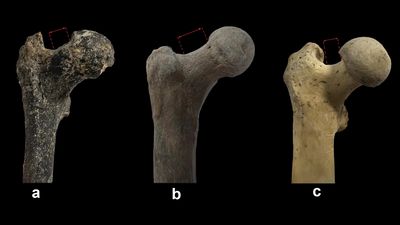
Yet a newly-unearthed Graecopithecus thighbone from the Azmaka archaeological site in Bulgaria provides unprecedented insights into the locomotive capabilities of this prehistoric being. Belonging to a female individual that weighed about 24 kilograms (53 pounds), the ancient limb displays an elongated femoral neck, which is usually seen as a diagnostic trait of bipedal walking.
"At 7.2 million years old, this ancestor, which we classify as belonging to the genus Graecopithecus, could be the oldest known human," said Professor David Begun from the University of Toronto in a statement.
Describing the find in a new study, Begun and his colleagues explain that the Azmaka fossil can be grouped with Orrorin, as well as later hominins such as Australopithecus, Paranthropus, and, ultimately, the Homo genus.
Despite this, the researchers explain that Graecopithecus probably wasn’t a "true biped", as certain "biomechanical differences" distinguish it from the most advanced hominins. They therefore conclude that it probably moved around using a combination of bipedal and quadrupedal locomotion, but that it wasn’t well adapted to life in the trees like chimps and other hominids.
"The morphology indicates a transitional form of bipedalism," write the study authors. This, they say, indicates that "the acquisition of bipedalism in hominins was a multiphase process."
Inserting Graecopithecus into the wider story of human evolution, the researchers say it probably evolved from older Eurasian primates like Ouranopithecus and Anadoluvius. However, as forests disappeared and parts of the eastern Mediterranean and western Asia turned to deserts in the late Miocene, the need to come out of the trees and adapt to life on the ground put selective pressure on bipedalism.
Ultimately, these first bipeds may have then migrated to Africa, later giving rise to Orrorin and all subsequent hominins – including us.
"Graecopithecus represents a stage in human evolution between our arboreal and ground-dwelling ancestors," said Begun. "One could certainly describe it as a missing link."
The study is published in the journal Palaeobiodiversity and Palaeoenvironments.