


 Humans
 PUBLISHED



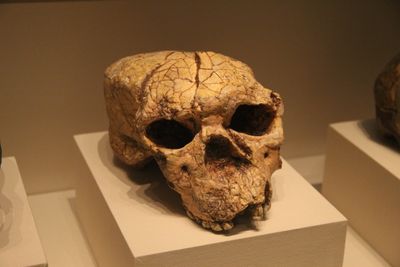


There were some interesting characters walking around East Asia during the Middle Pleistocene. Not quite as primitive as Homo erectus but not as advanced as modern humans, this cast of hominins are notoriously difficult to name or classify. Now, however, scientists are starting to build a picture of what was going on during this confusing period of human evolution.
Hominins first appear in the Chinese fossil record a little under 1.8 million years ago, and these early arrivals are widely recognized as a species called H. erectus. About a million years later, however, things get messy once a range of so-called “transitional” specimens start showing up.
With features that fall somewhere inbetween those of H. erectus, Neanderthals and modern humans, these unusual creatures display a huge degree of morphological variability. This has led to disputes over how many different human species actually lived in China during this period, which is appropriately referred to as the "Muddle in the Middle".
In 2021, scientists made a breakthrough when they classified a 140,000-year-old skull from Harbin, Heilongjiang Province, as a new species named Homo longi − or Dragon Man. They also noted that the morphology of this species' cranium is more similar to our own than Neanderthals, which makes them our sister clade on the hominin family tree.
Meanwhile, DNA and protein evidence has built up that places many Asian hominin fossils in a group called the Denisovans. This group has traditionally been considered more closely related to Neanderthals, and yet the Harbin skull itself carries Denisovan DNA − raising the question of where exactly Denisovans fit in our family tree, and whether H. longi and the Denisovans are one and the same.
One school of thought says yes, and proposes that many of the Chinese fossils belong to H. longi, and that H. longi is a classification that contains the Denisovans. But other researchers champion the idea that at least some Chinese Denisovans are part of a separate population, meaning we are seeing the remains of two distinct lineages.
Based on analysis of 200,000-year-old remains from Xujiayao, this second proposed group has been named Homo juluensis, and is suggested to be more closely related to Neanderthals than to our own clade.
The confusion doesn't end there, however. Weirdly, it seems the longi clade also includes Homo antecessor, which first appeared in Spain about 850,000 years ago, suggesting that this grouping was widespread across Eurasia long before our own species came into existence.
And when you consider that our species is thought to have first appeared in Africa, the picture becomes even more confusing. After all, if H. longi is our sister then we must share a common ancestor with this lineage. Whether that ancestral species lived in China, Spain, Africa or somewhere else, however, remains an ever deepening mystery.
Summarizing the many twists and turns in this convoluted evolutionary story, the authors of a new study say that we only know one thing for sure: China wasn’t just a place where H. erectus went to die; it was the stage for a fascinating human saga that saw multiple related lineages rise and fall, eventually resulting in the disappearance of all hominin species apart from our own.
“Rather than an evolutionary cul-de-sac, China now appears as a dynamic evolutionary crossroad where multiple Homo lineages may have arisen, interacted and adapted to shifting environments,” they write. Looking ahead to the next chapters in this unfinished epic, they suggest that “as the fossil record expands, more hominins linked to the sapiens clade are likely to emerge across Eurasia.”
The study has been published in the journal Nature Ecology & Evolution.


 1
1