Nature
 PUBLISHED
 4
4



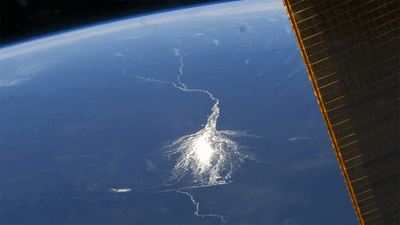


Over on Reddit, people with an interest in finding unusual features on maps have noticed that the Okavango River in Africa begins and ends without ever making it to the sea. They have a few questions, the main one being, how does that work? So, how does that work?
The river in question is the Okavango River, the fourth-longest river system in southern Africa, stretching some 1,600 kilometers (1,000 miles) southeastwards across the continent, from Angola to Botswana. Like many – though not all – rivers, it has its origin in the mountains, starting around 1,780 meters (5,840 feet) above sea level on the Bié Plateau in central Angola.
Most rivers on Earth begin at high elevations and move down and across lands, thanks to our old friend and mighty foe gravity, before reaching and draining into the sea at an estuary.
"Estuaries and their surrounding wetlands are bodies of water usually found where rivers meet the sea," the National Oceanic and Atmospheric Administration (NOAA) explains. "Estuaries are home to unique plant and animal communities that have adapted to brackish water—a mixture of fresh water draining from the land and salty seawater."
But that isn't true of every river, as the Okavango demonstrates nicely. Some rivers end in endorheic basins, or drainage basins that don't have an outlet, instead draining by evaporation or by seeping into the ground. Though this type of river is rarer, these often seasonal basins cover a large area of the planet.
"Global endorheic basins, where surface flow is landlocked from the ocean, cover a fifth of the Earth’s land surface but nearly half of its water-stressed regions," a study looking into the decline of these basins' storage explains.
"Many arid and semiarid regions are inherently endorheic, where surface flow is unable to break topographic barriers, and retained in landlocked storage that equilibrates through evaporation. Because surface flow is scarce in endorheic regions, water storage, particularly in sizable lakes, reservoirs, and aquifers, becomes of vital ecological and social importance."
The Okavango River – after flowing through Angola, briefly forming a stretch of the Angola-Namibia border and making its way to central Botswana – does this too, ending in the Okavango Delta, one of the world's largest endorheic deltas.
"This delta in north-west Botswana comprises permanent marshlands and seasonally flooded plains. It is one of the very few major interior delta systems that do not flow into a sea or ocean, with a wetland system that is almost intact," UNESCO explains of the delta, which is a World Heritage Site.
"One of the unique characteristics of the site is that the annual flooding from the River Okavango occurs during the dry season, with the result that the native plants and animals have synchronized their biological cycles with these seasonal rains and floods. It is an exceptional example of the interaction between climatic, hydrological and biological processes."
In short, the river is a beautiful oddity, traveling 1,600 kilometers (1,000 miles) across Africa, and never seeing the sea at all. Ultimately, nearly all of the water delivered by the mountains of Angola is exhausted in the dry Botswana sand, turning them into life-sustaining wetland oasis, before evaporating off the map.
"Most of the water from the Okavango River is consumed by forests or evaporates in the dry air," NASA writes of the river. "Only 2 percent of the river’s water actually exits the delta."