Nature
 PUBLISHED


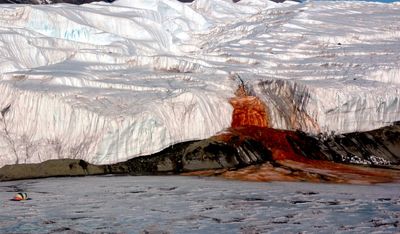


When British geographer Thomas Griffith Taylor made his daring venture through East Antarctica in 1911, his expedition stumbled across a terrifying sight: the edge of a glacier appearing to ooze a stream of blood. After a century of speculation, the cause of the Blood Falls has been pinpointed.
Scientists in the US used powerful transmission electron microscopes to analyze samples of Blood Falls' water and found an abundance of iron-rich nanospheres that turn red when oxidized.
"As soon as I looked at the microscope images, I noticed that there were these little nanospheres and they were iron-rich, and they have lots of different elements in them besides iron – silicon, calcium, aluminum, sodium – and they all varied," Ken Livi, a research scientist in the Whiting School's Department of Materials Science and Engineering at Johns Hopkins University, said in a statement.
Known for its rich red color, iron oxide had previously been a prime suspect in the mystery of Blood Falls. However, this fancy imaging technique has helped researchers get a clearer picture of why its leaking waters are such a vibrant red hue – and why some previous studies have fallen flat.
"In order to be a mineral, atoms must be arranged in a very specific, crystalline, structure. These nanospheres aren't crystalline, so the methods previously used to examine the solids did not detect them," explained Livi.
You might assume its blood-red waters are the most unusual feature of the Antarctic’s Blood Falls, but this geological feature is full of oddities.
Scientists have found that the red water seeping out of the Blood Falls originates in a saltwater lake that’s lain trapped in the ice for 1.5 to 4 million years. In fact, this lake is just one part of a much larger underground system of hyper-salty lakes and aquifers.
Analysis of the water indicated that the buried bodies of super salty water are home to a rare subglacial ecosystem of bacteria – despite an almost total absence of oxygen. This means the bacteria are persisting for millions of years without photosynthesis and likely sustain themselves through cycling iron from the brine.
Given these otherworldly properties, scientists believe that Blood Falls could be studied to gain a deeper understanding of other planets elsewhere in the solar system.
"With the advent of the Mars Rover missions, there was an interest in trying to analyze the solids that came out of the waters of Blood Falls as if it was a Martian landing site," Livi said. "What would happen if a Mars Rover landed in Antarctica? Would it be able to determine what was causing the Blood Falls to be red? It's a fascinating question and one that several researchers were considering.”
The new study was published in the journal Frontiers in Astronomy and Space Sciences.