


 Space and Physics
 PUBLISHED


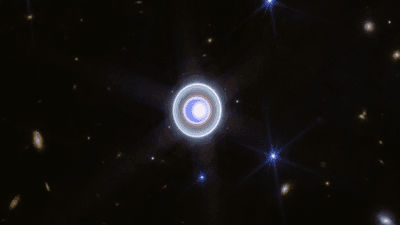


The rings of Uranus were only discovered in 1977 and the outer rings, named for the Greek letters μ and ν (mu and nu), have been a nice puzzle. First of all, they are different colors, with ν being redder and μ being bluer. This already hints at a difference in composition. New research now suggests a different origin for the two altogether.
Researchers have combined observations from JWST, Hubble, and the Keck Observatory to better understand what these rings are made of and where they come from.
“By decoding the light from these rings, we can trace both their particle size distribution and composition, which sheds light on their origins, offering new insight into how the Uranian system and planets like it formed and evolved,” lead author Imke de Pater, professor at the University of California, Berkeley, said in a statement.
Both rings shared an absorption feature in near infrared at a wavelength of 3 microns. That’s it: they have nothing else in common. The ν ring is more than just plain old rocky material. Between 10 and 15 percent of it is mixed with carbon-rich organic compounds; these are common in the outer Solar System.
The μ ring is likely to be made of tiny icy grains, which will explain its blue color. The only other blue ring in the Solar System is Saturn’s E ring, formed by the plumes released by its moon Enceladus. There are no plumes in the Uranus system that we know of. This ring comes from icy grains thrown into orbit by micrometeorite impacts on Mab, one of the smallest of the 29 known moons of Uranus. It’s only 12 kilometers (7.5 miles) across.
“In contrast, the ν ring material is sourced from micrometeorite impacts on and collisions between unseen rocky bodies rich in organic materials, which must orbit between some of the known moons,” explained de Pater. “One interesting question is why the parent bodies sourcing these rings are so different in composition.”
It is a really interesting question with no clear answer. The planet and its system are full of mysteries. Uranus orbits on its side, it has very peculiar magnetosphere that doesn’t go through its center, and more weirdness besides. Rings from different sources might not be worth losing sleep over, but all these mysteries would benefit from seeing a mission to the planet.
“I suspect we will need closeup images from a future spacecraft mission to Uranus in order to answer that question”, said Mark Showalter, co-author and senior research scientist at the SETI Institute.
Until NASA’s Uranus Orbiter and Probe is greenlit or another space agency takes the opportunity, telescopes on Earth or nearby are all we've got to study this distant world.
“We see hints that the µ ring’s brightness changes over time, and what could be causing those changes is still a mystery,” added Matt Hedman, co-author and professor at the University of Idaho.
The study is published in the journal JGR Planets.

 1
1