Space and Physics
 PUBLISHED




Eyes on the sky! There are many cool things to see in the heavens this month, starting this week. What might be the best comet of the year will pass near the Sun and the Earth; the Moon will block the Pleiades; and we are even going to get a nice meteor shower, as the Lyrids peak next week.
Let’s start with the comet. Its designation is C/2025 R3 (PanSTARRS) and it is likely to be the best comet of the year. It won’t be a majestic spectacle like Hale-Bopp, the Great Comet of 1997, but you can already see it without a telescope. It is already visible to the naked eye in the pre-dawn sky, but NASA recommends April 17 for the best date to see it – shortly before the closest approach to the Sun, but still a good angular distance away to be seen from Earth.
If you miss it, this will be it for Comet C/2025 R3 – its orbit suggests that it will leave the Solar System, never to be seen again!
After sunset on April 19, the Moon will be in a thin crescent and will pass on top of the Pleiades, also known as the Seven Sisters in the West, a group of stars forming part of the Taurus constellation. Near this occultation, you can also see Venus fairly high up in the sky – it's difficult to miss. With a small telescope, you can also see Uranus right under the Moon, and if you get clouds, the Virtual Telescope team will have you covered with a livestream (from 12 pm EDT).
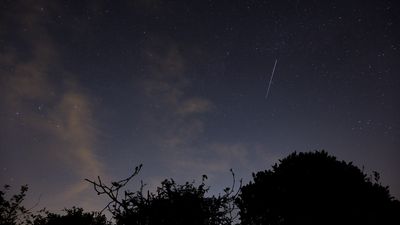
Last but certainly not least, the Lyrid meteor shower. The meteors appear to radiate from the constellation of the Lyre, and the shower is active from tomorrow, April 14, until April 30. The shower will peak on the night between April 21 and 22 with a Moon that is only 27 percent full, making it pretty ideal to spot these shooting stars.
"There are always a couple of factors that go into whether a meteor shower is worth staying up late to watch or not,” Dr Nick Moskovitz, a planetary astronomer at Lowell Observatory in Flagstaff, Arizona, told IFLScience.
“Whenever you want to go out and watch meteors, you want to make sure the skies are really dark. One of the main factors, and maybe the main factor, is what the Moon is doing. This year, the moon's in a favorable phase for viewing the Lyrids.”
The second important factor is what the meteor shower is predicted to do. In the past, the Lyrids have been responsible for incredible events, such as the meteor storm of 1803, which was discussed by a journalist in Richmond, Virginia; the storm of 687 BCE, described in the Zuo Zhuan, an ancient Chinese narrative history; or even older descriptions found in Indigenous Australian astronomy.
Unfortunately, this year we are not expecting anything spectacular. The hourly rate at peak is set to be about 20 meteors, which roughly doubles the number of meteors on an average night. The Lyrids are debris left over by Comet C/1861 G1 Thatcher, a long-period comet that goes around the Sun every 415 years or so. When the Earth crosses the orbit of this comet, some of the debris falls down, and we see it as meteors.
The larger the particle, the brighter and more dramatic the meteor.
Dr Nick Moskovitz
“The thing that could be exciting, if you get lucky, is that the Lyrids can have large particles in the meteor stream, and the entry speed for the Lyrids is something like 30, 40, 50 kilometers per second, which is like 100,000 miles per hour,” Dr. Moskovitz told IFLScience.
“So you're talking about a little material coming in at ridiculously high speed, and that's why you see this bright flash of light as a shooting star. That can be more exciting because the larger the particle, the brighter and more dramatic the meteor.”
The larger particles are still pretty small, ping pong ball-sized to apple-sized, but they can create some pretty bright streaks, so even when the Lyrids are not in storm mode they can still deliver some spectacular sights.
For best viewing conditions, pick an area with a dark sky and low light pollution. The darker the better. This week is International Dark Sky Week, and the Lowell Observatory is hosting a virtual event all about it.
Lowell is an astronomical institution, being the place where Clyde Tombaugh discovered Pluto in 1930, as well as conducting fundamental observations that led to the discovery of the expansion of the universe. It is still an active working observatory. Dr Moskovitz, with his colleagues Dr Brian Skiff and Tom Polakis, contributed to the observations in NASA's Double Asteroid Redirection Test (DART), when humanity purposely crashed a spacecraft into an asteroid to change its orbit. This was a fundamental test of planetary defense.