Space and Physics
 PUBLISHED




Mars is the second smallest planet in the Solar System, but it has record-breaking features that are truly incredible. One of them is Olympus Mons.
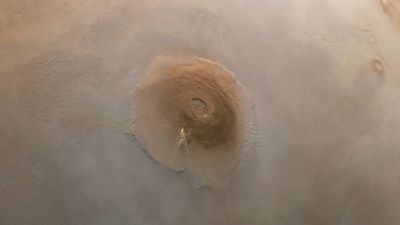
Olympus Mons is a gorgeous place full of intrigue, but more importantly, it is the largest volcano in the Solar System. When we say "large," we do not mean "oh, it is big" – we mean it is freaking enormous, as a newly processed image of the behemoth taken by the European Space Agency's Mars Express orbiter and processed by Andrea Luck shows.
This shield volcano is about 600 kilometers (373 miles) in diameter, roughly the size of the state of Arizona. It is also the tallest mountain in the Solar System, with an estimated height of around 21 kilometers (about 13 miles), though there’s a range depending on how you measure it.
If we were to keep it in the same proportion of volcano to Mars, and create something similar on Earth, we would end up with a mountain that towered about 40 kilometers (25 miles), around five times Mount Everest's (which we have all been pronouncing wrong) elevation from the sea level and four times Mauna Kea’s elevation from the seafloor.
Olympus Mons is so large and tall, that you wouldn’t be able to stand on it and appreciate how big it is. The slope is so gentle that even if you were on top of the volcano, the horizon wouldn’t be more than 3 kilometers (1.9 miles).
The volcano began to grow 3.5 billion years ago, but lava has been flowing until very recently. Estimates have placed lava that could be just 25 million years old, if not as young as 2 million years old. At that time on Earth, some of our hominid ancestors were already faffing about!
To add to all this wonderment, recently researchers discovered that there is water ice frost on top of the Martian volcanoes, including Olympus Mons. This was not expected.
“We thought it was impossible for frost to form around Mars’s equator, as the mix of sunshine and thin atmosphere keeps temperatures relatively high at both surface and mountaintop – unlike what we see on Earth, where you might expect to see frosty peaks,” lead author Adomas Valantinas, who made the discovery as a PhD student at University of Bern and is now a postdoctoral researcher at Brown University, said in a statement.
“Its existence here is exciting, and hints that there are exceptional processes at play that are allowing frost to form.”
If you want to pull a Shania Twain and not be impressed much by all of this, let us mention one final thing. There are two large craters on Olympus Mons: Karzok Crater and Pangboche Crater. They are believed to be the source of shergottites, the most abundant class of Martian meteorite.
So yes, it has got the looks, and it has got something you can touch. And if it is still active, it might even keep future astronauts warm in the middle of the night.