Nature
 PUBLISHED


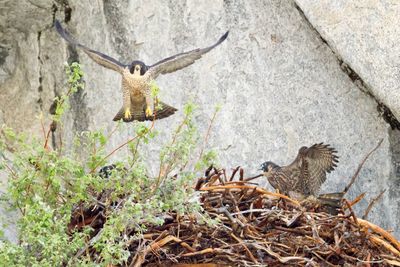


Yosemite National Park in California is a hub of wildlife – and birds in particular love to call it home. But out of the more than 260 species of feathery critters that live there, one has had a hard go of it in recent decades: the peregrine falcon.
“Peregrine falcons are one of the most majestic and powerful birds in the world, and they are so quintessential to the cliffs of Yosemite,” said Sarah Stock, wildlife ecologist at Yosemite National Park, in a 2022 video for Yosemite Conservancy.
But “in the 1940s, peregrines undertook this precipitous decline,” she explained. “[And] by the 1970s, peregrines were pretty much gone.”
Today, though, peregrine populations are soaring, no pun intended. So how did the species go from the very edge of extinction in the US to a modern success story?
A species in decline
It was 1944, and the world was in a bad way. Europe had been at war for half a decade; Asia was either fighting their own gruesome battles or being dragged out west to face down fascists too; Russia was starving, and everywhere – everywhere – people were getting sick.
There were typhus epidemics in Italy and Russia. Mosquitoes in the stagnant water around military camps, bringing malaria to soldiers waiting to fight. A myriad concentration camp prisoners, living in enforced squalor and crawling with disease-carrying lice. It was a humanitarian double-dip disaster waiting to happen – and then, something miraculous happened.
A chemical, first synthesized decades beforehand but considered little more than an interesting chapter in the thesis of the grad student who discovered it for about 60 years, had recently been rediscovered by one Paul Müller, a chemical engineer at the Swiss firm Geigy – and it had incredible insecticidal powers. Field tests had proven its mettle – it had basically saved the Swiss potato crop in 1939 – and it had now, finally, been brought into mass production. The US Army bought tons of the stuff, using it on people, water, the environment, and later bringing it back home to revolutionize American agriculture.
It ”seem[ed] like the answer to everything,” historian of medicine Elena Conis told Civil Eats back in 2022. “People became dependent on it really quickly because they didn’t have to go to great lengths to rid their houses of ants or roaches, or their whole community of flies or mosquitoes.”
“It [made] agriculture more profitable – because with a sweep […] farmers could eliminate some of the worst pests,” she explained. And it became part of the national story: “Americans constantly heard about how [it] had protected our troops, prisoners of war, and refugees from malaria and other devastating diseases. The chemical, they were told, had essentially transformed the war.”
There was just one problem. This chemical? It was dichloro-diphenyl-trichloroethane – or, in more common parlance, DDT.
Today, DDT is one of the most notorious poisons in recent history. While seemingly safe for non-insects in the short term, after years of use it was deadly. By the 1960s, people had started noticing that fish and birds were dying en masse where the chemical was used – and the peregrine falcon, along with other iconic birds of prey like bald eagles, ospreys, and brown pelicans, were no exception.
“By the 1970s, peregrines were pretty much gone from the Eastern US,” Stock said, “and barely hanging on in the West.”
“We did not have any nesting peregrines in [Yosemite] Park for over 30 years.”
Back from the brink
The Endangered Species Act was passed in 1973, one year after the US banned DDT, and peregrine falcons were one of the first animals to make the list. But for many at the time, it may have seemed too late – for all anybody knew, the birds were gone from Yosemite.
Then, in 1978, they suddenly weren’t. “Climbers were scaling El Capitan and they discovered an active peregrine nest,” Stock explained. “And this was really what spurred a lot of the recovery efforts in the park.”
It was an odd alliance: the avid climbers, who would scale the cliffs to find peregrine nests, take the DDT-contaminated eggs and replace them with dummies, and the biologists at the Santa Cruz Predatory Bird Research Group who incubated and hatched them in the safety of a lab. “Then the chicks were brought back up to the wall and swapped [back in],” reported James McGrew, a Yosemite Park Ranger Naturalist. “And reportedly within minutes their parents were coming back, saying ‘well that was fast! We’d better get some food!’”
“They were rapidly bringing food in to these chicks, and that was the first successful nest augmentation in Yosemite,” he said. “And [it was] the beginning of that wonderful ray of hope, and bringing them back, and their path to recovery.”
In 1995, there were five pairs of peregrines documented in Yosemite. By 2022, there were 13. Last year, park rangers counted 17 breeding pairs across 15 active nests – the highest number found in any year – with seven of those new for 2025. In total, more than 1,000 young peregrines have been released into the wild, with more than one-third of that number being hatched in Yosemite alone.
The numbers may not be huge – but they’re steady, and trending upwards. “Peregrines are at the top of the food chain and the most susceptible to contamination,” Frank Dean, president of Yosemite Conservancy, told the San Francisco Chronicle in 2024. “So to have them bounce back to this degree is a sign of the health of the entire Yosemite ecosystem.”
Back in the air
Today, peregrines are no longer considered endangered in the US – though, in California, they enjoy “fully protected” status, outlawing their hunting, harming, or killing for any reason outside of authorized scientific research. The park sees partial closures each year at nesting time, and a dedicated peregrine surveyor monitors the birds daily, looking out for their safety and wellbeing.
“The peregrine story is, arguably, a grand success story,” Stock said, “and I think we really need this positive story, because it motivates us to know that success stories are possible.”
“With the banning of DDT, we don't have this poison in the environment anymore,” she said. “And that's really a testimony to how humans can right a wrong, and bring an animal back that is so important to an ecosystem like Yosemite.”