Space and Physics
 PUBLISHED
 1
1




If you want to get chilly, you can’t beat -273.15°C. Literally: that’s absolute zero, the theoretical state at which a system’s internal energy and entropy levels reach their minimum values. That’s the coldest it’s physically possible to be.
Well, kind of. See, it’s actually not physically possible to reach absolute zero – despite humanity’s best efforts, there’s nowhere in the whole universe that is that cold.
But there’s somewhere that gets close.
What is the coldest place in the universe?
Out in space, the only heat comes from the occasional objects and particles floating about throughout the universe. The stars, planets, gases, even the dust – all of it emits some amount of heat, even if it’s tiny.
So, logically, if you’re looking for the coldest place possible, you’re going to want to think remote. Somewhere out in space, as far as possible from any heat source at all – a kind of interplanetary Point Nemo, if you like. At that place, wherever it is, all there would be is the cosmic microwave background: the lingering, infinitesimally low-energy aftershocks of the explosion we know as the Big Bang.
Now, that’s pretty cold. At about 2.7 Kelvin – that’s -270°C or -459°F – it’s less than 3°C, or 5°F, above absolute zero. It’s definitely a contender for the chilliest place in the universe – but it’s not the winner.
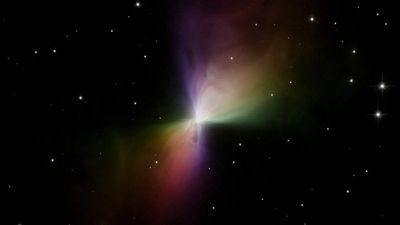
In fact, and perhaps counterintuitively, it’s beaten by a nebula. The Boomerang Nebula, to be precise: a young planetary nebula about 5,000 light-years away, in the Centaurus constellation.
“The Boomerang Nebula is one of the Universe's peculiar places,” says the European Space Agency (ESA). “With a temperature of -272°C [-457.6°F], it is only one degree warmer than absolute zero (the lowest limit for all temperatures).”
“It is the only object found so far that has a temperature lower than the background radiation.”
What is the Boomerang Nebula?
As you might expect, it takes a very particular set of circumstances to make something this cold. In the Boomerang Nebula’s case, it owes its extreme temperatures to its age; it’s what’s left of a star in the very last stages of its life.
Oh yes: don’t let the term “young planetary nebula” mislead you – it, rather confusingly, refers to something neither planetary nor particularly young. Remember: a star is basically just a ball of hot nuclear reaction; a way of converting (mostly) hydrogen into heat, light, and (mostly) helium – and as with any such conversion, once you run out of fuel, the fire goes out.
“At the beginning of the end of a star’s life, its core runs out of hydrogen to convert into helium,” explains NASA. “The energy produced by fusion creates pressure inside the star that balances gravity’s tendency to pull matter together, so the core starts to collapse. But squeezing the core also increases its temperature and pressure, making the star slowly puff up.”
Exactly how fast and how dramatically this happens depends strongly on the mass of the star. Smaller ones, like our Sun, will just expand into a giant star as they die; stars that are already giant might become unstable, and start inflating at random intervals, ejecting their atmospheres as they do so.
But however the end comes, eventually, all the star’s outer layers are blown away by stellar wind, usually leaving behind a round, blown-out bubble in space. That’s why they’re called “planetary nebulae”: not because they have anything to do with planets really, but because they tend to look a bit spherical, like a planet.
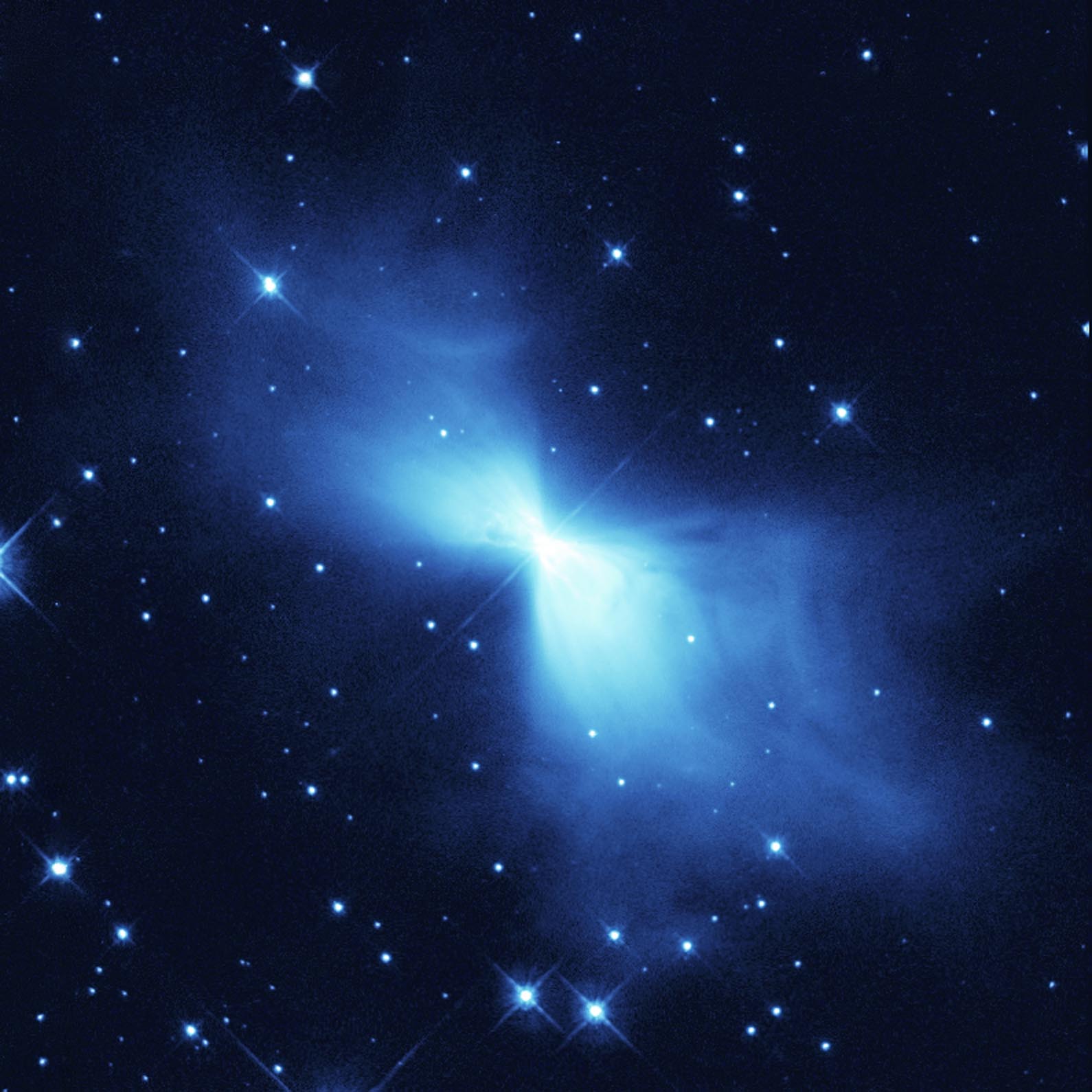
Now, the Boomerang Nebula does not fit this pattern – as its name suggests, it doesn’t really look very spherical at all. As its name may not suggest, however, it doesn’t look like a boomerang either – but when it was first discovered by astronomers Keith Taylor and Mike Scarrott, working with a ground-based telescope in Australia back in 1980, it kind of did. Not because it’s changed shape, mind you – it’s just that modern stargazing technology, and the Hubble Space Telescope in particular, is way, way better at seeing these things.
At the time, “the astronomers saw merely a slight asymmetry in the nebula's lobes suggesting a curved shape like a boomerang,” explains ESA. “The high-resolution Hubble images indicate that a better name would perhaps have been the ‘Bow Tie Nebula’.”
Why is the Boomerang Nebula so cold?
It would take 15 years after its discovery for this strange nebula to earn its status as the universe’s East Antarctica. That was when Raghvendra Sahai and Lars-Åke Nyman, astronomers at Caltech and the European Southern Observatory respectively, first pointed their telescope at the nebula and discovered that it was actually absorbing the microwave background radiation – something mathematically impossible unless it was ejecting so much material, so fast, that it just wasn’t keeping any heat for itself.
But here’s the thing: obviously, the Boomerang Nebula isn’t the only planetary nebula expelling mass out there, but it is the only one doing so at rates 10 to 100 times faster than everyone else. Clearly, there’s something extra-special going on there that isn’t found in other nebulae – and, when Sahai, Nyman, and Chalmers University of Technology astronomer Wouter Vlemmings took a deeper look back in 2017, they figured out what it was.
“Most of the stellar envelope from the massive red giant star has been blasted out into space at speeds far beyond the capabilities of a single, red giant star,” said Sahai, by that point an astronomer at NASA's Jet Propulsion Laboratory, at the time. “The only way to eject so much mass and at such extreme speeds is from the gravitational energy of two interacting stars.”
It’s for that reason that Sahai and his colleagues concluded that the Boomerang Nebula isn’t just the last gasp of a dying star, but of two: it “appears to have resulted from a strongly interacting binary system,” they wrote, “in which a very significant fraction of the primary star’s envelope was ejected […] as the companion spiraled in toward the latter’s core.”
Will the Boomerang Nebula always be the coldest place in the universe?
The Boomerang Nebula has been expelling its material for about 3,500 years right now, which isn’t very long at all in stellar terms. But it can’t last forever – and observations have shown it’s already warming up.
Overall, we shouldn’t expect these super-cold temperatures to last longer than a few more millennia – which, given the Boomerang Nebula’s place 5,000 light-years away from us, means it could be already gone. But with its quick demise comes a more uplifting corollary: that somewhere out there, another one may well be forming right now.
“It's possible these super cosmic freezers are quite common in the universe,” confirmed Nyman. “But they can only maintain such extreme temperatures for a relatively short time.”
“We see this remarkable object at a very special, very short-lived period of its life,” he said. After that, who knows where the coldest place will be.