Space and Physics
 PUBLISHED


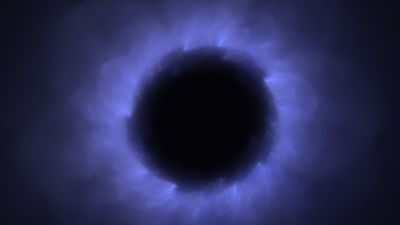


Another week, another viral post misrepresenting space. This time it's the turn of Barnard 68, which – if the Internet is to be believed (which it's not) – is "an empty void in space so big that if you traveled across it you wouldn’t bump into anything for 752,536,988 years".
While it's smart not to specify a speed (hey, it's technically true that if you traveled at a few meters a year, you probably wouldn't bump into anything in 752,536,988 years), this is definitely not the case.
What you're seeing above is a real image of the dark nebula Bernard 68, which is so close (400 light-years) that nothing can be seen between it and the Sun, taken by the European Southern Observatory's (ESO) Very Large Telescope in March 1999. However, it is absolutely crammed full of stars, even if you can't see them when imaging the area using visible light, thanks to the molecular cloud. As ESO explains, "at these wavelengths, the small cloud is completely opaque because of the obscuring effect of dust particles in its interior."
If you image it in infrared, it's stars aplenty.

But fans of big weird voids in space, do not despair, for there are plenty of mysteries out there in the endless expanse of the cosmos.
The Great Nothing: an actual void in space
The Boötes void, often referred to as the Great Nothing or the Great Void, is a real massive spherical area of space with fewer galaxies than you'd expect. At around 330 million light-years across, it is the largest void in the known universe, or a "supervoid". To put that in context, that's about 2 percent of the diameter of the entire observable universe.
There are other known voids. The Milky Way lies in a void called the KBC Void, or Local Hole. But none are as big as Boötes, which is about 700 light-years from Earth.
The void was first discovered in 1981, in the course of a redshift survey of galaxies. Publishing their results in a paper titled "A million cubic megaparsec void in Boötes?", astronomers noted that one plausible interpretation of the data they had collected was that the area is "nearly devoid of galaxies."
Slowly, astronomers began to find galaxies in the region, and by 1997, around 60 galaxies had been confirmed in the Great Nothing in an area that should contain approximately 2,000 galaxies (if space was that uniform, of course). While there is little about the void to suggest our ideas about galaxy formation is incorrect, one possible explanation is that it formed from smaller voids merging.
The size of the void and the fact that there are some galaxies, if not many, rules out the posibility of the void being a black hole.
As astronomer Greg Aldering put it: "If the Milky Way had been in the center of the Boötes void, we wouldn’t have known there were other galaxies until the 1960s.”