Nature
 PUBLISHED
 2
2



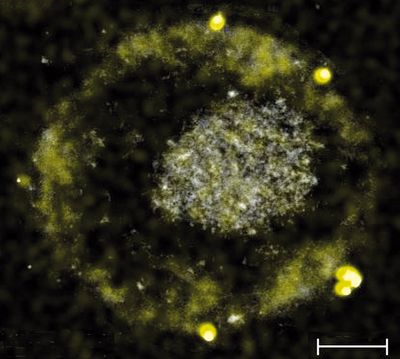


It might not have a place in a fairytale like the goose that laid golden eggs, but there's a bacterium that can absorb compounds rich in toxic metals and extract gold from them, producing tiny gold nuggets.
The bacterium in question is called Cupriavidus metallidurans and lives in soil rich in toxic elements. As reported in Metallomics in 2018, an international group of researchers worked out the molecular processes that allow this biological gold deposit.
It all has to do with how it deals with copper and gold in the soil. Both copper and gold are toxic in large quantities, but the bacterium has evolved to need copper to survive.
The soil that C. metallidurans live in is rich in toxic heavy metals, which the bacterium converts into a form that is easier to be dealt with. If too much copper is present, the bacterium can activate a special enzyme, called CupA, which can pump out all the excess copper and keep the bacterium healthy.
"Apart from the toxic heavy metals, living conditions in these soils are not bad," senior author Professor Dietrich H. Nies, a microbiologist at the Martin Luther University Halle-Wittenberg, said in a statement.
"There is enough hydrogen to conserve energy and nearly no competition. If an organism chooses to survive here, it has to find a way to protect itself from these toxic substances," explained Professor Nies.
However, something peculiar happens when gold is present. Copper gold compounds are extremely toxic, so the bacterium needs to protect itself. To do this, the CupA is made inactive and a different enzyme, CopA, is made active. This transforms the copper and gold compounds into forms that are difficult to absorb.
"This assures that fewer copper and gold compounds enter the cellular interior," added Nies. "The bacterium is poisoned less and the enzyme that pumps out the copper can dispose of the excess copper unimpeded. Another consequence: the gold compounds that are difficult to absorb transform in the outer area of the cell into harmless gold nuggets only a few nanometres in size."
An earlier version of this article was published in February 2018.