Humans
 PUBLISHED




Disease has been an ever-present threat to human society. History is filled with situations where an infection has entered a population and caused dramatic shifts in behavior as people attempt to deal with it. The great plagues of the medieval and early modern era may jump to mind here, or perhaps the cholera outbreaks that swept across Europe during the 19th century. Or maybe your mind is drawn to more recent events, such as the 2020 COVID-19 outbreak. Anyone who lived through that experience will know that everyday life can be dramatically transformed when a new disease comes to town.
But how do archaeologists or paleoanthropologists learn about illnesses that either affected prehistoric peoples who left no records, occurred in isolated locations, or were so “ordinary” to the population that no one thought to mention them? As tricky as this situation may sound, it is not an insurmountable one.
Paleopathology is the study of diseases that archaeologists can identify by examining a range of sources of data. This can include skeletal remains or soft tissues, as well as certain artifacts or contexts where biological matter can be preserved. The examination of diseases from the past can offer various insights that are important today. For instance, they can give us insights into the daily lives of people who lived with specific illnesses – such as their diets, their environments, and the surrounding sanitation – while also offering us a glimpse of how they may have dealt with these conditions. But an examination of long-dead infections can also offer us a better understanding of how diseases present today have evolved and how they may change in the future.
So how do scientists identify these diseases? Of course, paleopathology is a complex and evolving field, so a short article like this will never do justice to its details, but here are some of the main techniques archaeologists use.
Skeletal evidence
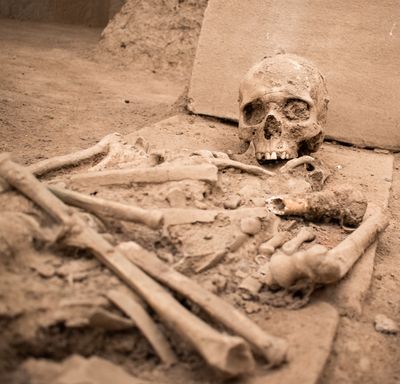
This is probably one of the more obvious sources of archaeological data. Rather than just being a calcium-rich structure of a dead person or animal, bones and teeth can tell you a wealth of information about a person’s life.
For instance, if someone experienced severe malnutrition as a child, their body goes through a phase where it slows growth and shifts to an energy-conservation mode. It starts to break down fat and muscle tissues for survival. This places the person under extreme physiological stress, which leaves trace evidence in their body. Under normal conditions, a person’s tooth dentine will contain chemical signatures – particularly of carbon and nitrogen isotopes – derived from their diets. But under times of stress, such as starvation, newly formed dentine can show a distinct isotope pattern that reflects the body recycling its own tissues.
Dentine doesn’t remodel later in life, so these isotope ratios become permanently preserved in a person’s teeth, allowing researchers to use them to identify episodes of childhood famine in past populations. In 2025, biological anthropologists used these signs to show the lasting damage malnutrition had on people living in the medieval period.
This is just one way that skeletal remains can offer insights into past health. There are also plenty of diseases that leave specific traces on our bones. Tuberculosis and syphilis are well known for producing telltale marks on human remains, often referred to as skeletal tuberculosis and syphilitic osteomyelitis, respectively.
In 2024, researchers examined four prehistoric skeletons found in Brazil, which showed evidence of being infected with Treponema pallidum, the bacteria that causes syphilis, bejel, and yaws disease. The results provided new clues as to the evolution of the venereal disease that has captivated research for centuries.
Soft tissues
Although skeletal remains are more common for ancient people, sometimes archaeologists find tissues that can also be studied. Mummies, be they artificially or naturally preserved, are a great example of this. Organs can offer direct signs of disease. For instance, CT scans of Egyptian mummies have demonstrated that some had calcified arteries, which is a clear sign of cardiovascular disease. So rather than being simply an issue for modern humans, it was also something that afflicted ancient populations. In fact, the high prevalence could suggest a more basic human predisposition to the disease, especially as the condition was found in mummies from Peru, southwest America, and the Aleutian Islands in Alaska.
If a body still contains its stomach, archaeologists can also gain a glimpse into the diets of ancient peoples. In 2024, researchers examined the remains of salt miners discovered in an Iranian mine that collapsed 2,500 years ago. Among the five bodies was one particular person whose stomach was infested with tapeworm eggs. The analysis of this find marked the oldest known example of this intestinal parasite in Iranian history.
Tuberculosis, as mentioned above, is not just a disease that marks bones. It can also leave clear evidence on lung tissue. Egyptian and South American mummies have shown such characteristic lesions in their lungs, which has helped scientists show that the disease existed long before modern urbanization.
DNA
One of the most transformative developments in the study of ancient disease came with the modern revolution in genetic research. Ancient DNA (aDNA) refers to any genetic material recovered from human remains or even from discrete pathogens that infected them. It can be found in bones, teeth, or preserved tissues. It can also be found in the material humans excrete, like in this recent study that examined parasites in human feces.
Ancient DNA is often fragmented or degraded, so scientists have developed various ways to piece together genomes from small or partial samples using specialized lab techniques. But with it, it becomes possible to identify exactly which disease a person suffered from. For instance, DNA extracted from medieval skeletons in London and other locations have confirmed that the Black Death was indeed caused by the bacteria Yersinia pestis.
More recent work has even shown that the Plague of Justinian, which devastated people along the trade routes of the Byzantine Empire around 541 CE, was most likely caused by a strain of this same bacterium. This finding adds further evidence to debates that have been taking place for decades.
Genetic analysis doesn’t just tell us about how diseases impacted humans; it can also reveal how they affected our ancient ancestors. In particular, researchers have suggested that viruses may have played a role in the extinction of Neanderthals. While searching for remnants of genomes in the remains of two sets of Neanderthal bones recovered from the Chagyrskaya cave in Russia, researchers from the Federal University of São Paulo found three types of DNA viruses dating to around 50,000 years ago: adenovirus, herpesvirus, and papillomavirus.
This made them the oldest known human viruses ever to be discovered. The results not only proved that it is possible to identify parts of viral genomes from archaeological samples, but that Neanderthals may have been afflicted with the same viruses that affect modern humans. Although it cannot be proven that these viruses were not the result of an accidental contamination, nor can it be truly said that they directly killed off the Neanderthals, it nevertheless adds weight to debates that viruses may have contributed to their ultimate demise.
There are, of course, many other ways that archaeologists and paleoanthropologists can study the diseases of the past, but these examples show just how much information we can glean from different sources. And while scientists are increasingly relying on ancient evidence to help understand how modern diseases are changing, the results all show that no matter when you were born, illness is very much part of what it is to be human.