Nature
 PUBLISHED
 1
1




The origins of teeth have long been debated. With some fishy ancestors exhibiting teeth-like structures on their skin, known as dermal denticles (and, by the way, some even have “teeth” on their eyeballs), researchers found themselves wondering: did teeth grow out from within? Or did they migrate from the body into the mouth? New research hopes to offer an answer
“The origin of oral dentition has been an intriguing debate,” wrote the authors of a study conducted at Penn State and published in the Journal of Anatomy.
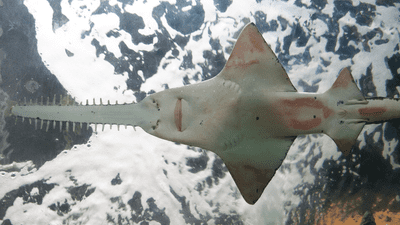
The debate between “outside-in” or “inside-out” hypotheses for the emergence of teeth has reportedly been settled following investigations into ancient sawfishes, Ischyrhiza mira, found in rock formations in New Jersey. And, the research suggests, "outside-in" might have it.
Teeth serve two key functions in the lives of most living toothed animals: to feed or to fight. Sawfishes are particularly interesting because their long rostrums are lined with curious denticles, which appear as if they could act as teeth in at least one of their leading functions.
To get a clearer picture of the function of these pointy structures, as well as those that sit on their skin and in their mouths, researchers decided to look at the teeth's histological composition. Using acid-etching techniques and scanning electron microscopy, they were able to identify that pointy structures within the mouth were “considerably more complex” than denticles elsewhere on the body.
Why is that? Well, eating is a pretty stressful ordeal, especially when you’re chomping down on live prey. It figures, therefore, that the greater stresses structures are put under, the more environmental pressure there is to adapt.
“The increased microstructural complexity observed in [sawshark] dentition is likely an adapted response to resist mechanical stress associated with feeding,” wrote the authors.
That the rostral and dental denticles are subjected to greater forces than those found more generally across the skin, particularly those at the peak of an animal’s noggin, could likely explain why these structures are more complex. The mechanical stresses associated with chomping, ripping, tearing, and self-defense likely explain, in Ischyrhiza mira at least, why they are more complex.
Therefore, it stands to reason that the more simplistic structures would exist in the point of origin where less mechanical stress was experienced. As these structures moved into the mouth and took on more responsibility, their internal structures adapted in response.
So there. That's some knowledge to chew on.