Nature
 PUBLISHED




We’ve known for a long time that the air is filled with life. A single cubic meter can contain millions of microbes, so it figures that some of it would get swept up in fog, too. But are those organisms active or just dormant cells enjoying the ride?
It’s a question tackled in new research that’s established that fog is home to a distinct microbial community that is alive, active, and growing. Sounds like bad news, but it actually comes with some great perks.
What is fog?
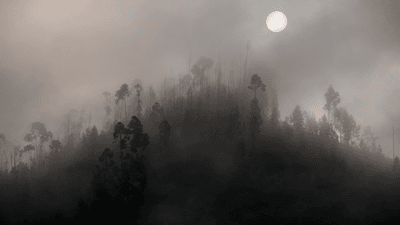
Fog has had a bit of a rough time of it from a PR perspective. The go-to pathetic fallacy tool when you want to indicate something paranormal is about to occur, in truth it’s nothing more than a cloud on the ground.
The Met Office defines fog as density of water vapor that reduces visibility to less than 1,000 meters (3,281 feet). Though it appears to us as a white haze, fog actually contains concentrations of bacteria comparable to the ocean, but is it a community unique to fog, or merely a random sample from the environment?
To find out, scientists sampled the air before, during, and after 32 fog events across a study period of two years. Back in the lab they compared the microbes present in the samples, as well as their abundance and size.
Life in a droplet
The results revealed that fog water droplets represent a major, concentrated bacterial biomass hub in the air. Despite being very small they contain concentrations comparable to that of a eutrophic lake or the ocean. Remind me to close my mouth next time...
The constituents of that microbial concentration are also distinct and not the same as those found in the surrounding air. Notably, fog samples were particularly rich in species from the Methylobacterium genus.
They weren’t merely riding passenger princess, either. The microbial communities were metabolically active and processing chemicals, especially formaldehyde. Famous for its use in embalming, formaldehyde is a natural pollutant that’s toxic to living things. Consider it a perk, then, that fog communities use it as food to support their growth.
Preserving ecosystem services
Studying the biological activities unfolding in clouds is a relatively new branch of science. We still don’t understand much of what goes on inside them, but in light of novel ideas for harvesting fresh water from fog, it’s critical that we find out. When weather phenomena provide you with ecosystem services for free, you don't want to lose out.
“If we harvest fog, we are getting rid of our little friends in the air,” said Ferran Garcia-Pichel, a co-author and the director of the Arizona State University Biodesign Center for Fundamental and Applied Microbiomics, in a statement. “We don’t know if that’s going to make a big impact or not, but we should be considering that.”
So, the next time the air gets thick don’t be too shy to go full Mayor Tom Loftis and alert others to the fact that “there’s something in the fog!” There really is, it just isn’t all that spooky.
The study is published in the journal mBio.