Nature
 PUBLISHED


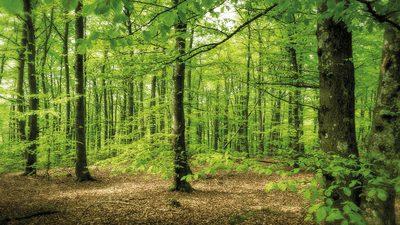


Beech trees across Europe have been mystifying plant scientists. Around the middle of June, trees across different cities, areas, and even countries and time zones would perfectly sync up and all together perform their reproductive behavior. Quite how the trees knew how to do this remained a mystery to scientists, until now.
Masting behavior involves the beech tree (Fagus sylvatica) producing all the seeds they need to make for the year, and then releasing their fruit onto the ground. These trees do this every year, but until now there had not been any explanation as to how they all managed to do it at the same time in so many different areas and climates.
The team looked at weather patterns and the plants' response to temperature changes, and found that the summer solstice and the longest day of the year acted as a trigger across beech trees in vastly different areas. The day of the solstice, all the beech trees become highly sensitive to temperature, which in turn triggers the production of the seeds. All European beech trees therefore start responding to the same signals in the same week.
“We got inspired by a recent Science paper where researchers from Switzerland found that the effects of temperature on leaf senescence switch at the summer solstice. The summer solstice is the longest day of the year, and happens at the same time anywhere in the Hemisphere," said study author Dr Valentin Journé, a postdoctoral researcher at Adam Mickiewcz University in Poznań, Poland, in a statement.
The team call this phenomenon a “celestial starting gun”, as it is the celestial cue that occurs at the same time across all the populations of European beech trees, a geographic range estimated to be around 2,000 kilometers (1,243 miles). A comparison showed that European beech trees have stronger spatial synchrony than any other species in Europe.
"The sharp response of beech trees is just remarkable. Once the day starts to shorten after the summer solstice, the temperature sensing window opens simultaneously, all across Europe," said Jessie Foest, a PhD researcher from the University of Liverpool. "What's truly jaw-dropping is that the change in day length that the trees are able to detect is really small – we are talking about a few minutes over a week. Apparently, trees are able to recognise the difference."
The fact that all these beech trees produce seeds together has important knock-on effects for the rest of the forest. These seeds are food for many creatures and reproductive failure of the beeches to produce them can have large effects on wildlife, causing famines, disrupting food webs, and even affecting the migration of birds and mammals.
The study is published in Nature Plants.