


 Space and Physics
 PUBLISHED



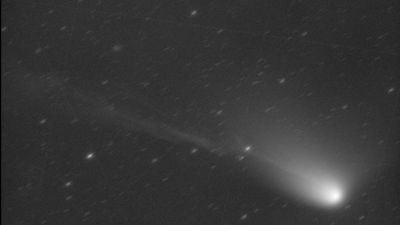


Comet 13P/Olbers is a period comet that visits the inner Solar System every 69 years. It flew past its closest point to the Sun on June 30 and is now on its long journey back away. But it has come at a particular active point in the solar cycle. The Sun is currently at or around its maximum most active peak and this is causing stunning aurorae on Earth, robots malfunctioning on Mars, and it's messing with Comet Olbers' tail.
A new picture taken by the team at the Virtual Telescope Project on August 8 shows the comet tail being dented, and the fault is not in itself but in our stars. Well, star. The Sun constantly releases a flow of plasma – the solar wind – and that shapes the material that evaporates from the comet into an ion tail.

During solar maximum, there are more dramatic events such as coronal mass ejections creating faster plasma but also a region of reduced plasma as the regular solar wind is swept by these solar tsunamis of particles. What that means for poor Comet Olbers is that its tail is getting all bent out of shape.
"The ion tail is basically caught up in that river," Henry Hsieh, a Planetary Science Institute researcher told Mashable. "You see a straight tail most of the time, but then every so often, you'll have this bit of a hiccup in the Sun — these coronal mass ejection events — where it'll just kind of send a particularly large or denser bunch of material outward."
You can also see colored photos of the comet and its ion tail taken by astrophotographer Dan Bartlett available on their Astrobin page.
Comet Olbers was first seen in 1815 by Heinrich Wilhelm Matthias Olbers who found a way to calculate the orbit of comets. Like many comets, Comet Olbers has an associated meteor shower but not on Earth. Those meteors fall on Mars.



 1
1