Nature
 PUBLISHED


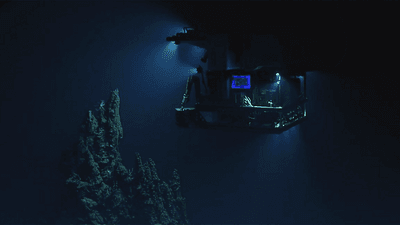


Researchers studying hydrothermal vents in the depths of the Pacific Ocean’s Mariana Trench have found tiny inorganic structures performing energy conversions associated with life.
There are a number of ideas about how life began on Earth, with the most widely favored being that it emerged near hydrothermal vents in the oceans billions of years in the past, providing the energy needed for the chemical reaction to take place that eventually led to the first living organisms.
Hydrothermal vents are small fissures in the ocean floor where seawater can seep through. As it does so, it gets heated by the Earth's magma and rises again, now containing dissolved minerals it picked up below. As the water cools again, these mineral ions become deposited in solid structures around the vents, termed precipitates.
The team took a closer look at a particular serpentinite-hosted hydrothermal vent, which has complex precipitate layers of metal oxides, hydroxides, and carbonates. Examining samples taken from the Shinkai Seep Field, which is 5,743 meters (18,842 feet) underwater, they discovered that the precipitate's surface was electrically charged, and that the size and direction of the charge on it varied.

Looking at the sample with a combination of optical microscopes and X-ray, the team found that brucite crystals were arranged in tiny nano-columns that acted as small vents, leading to a mechanism similar to how life uses osmotic energy conversion.
“Unexpectedly, we discovered that osmotic energy conversion, a vital function in modern plant, animal, and microbial life, can occur abiotically in a geological environment,” Ryuhei Nakamura, from the RIKEN Center for Sustainable Resource Science (CSRS) in Japan, said in a statement.
"Cells harvest energy from ionic gradients by selective ion transport across membranes, and the same principle is recently being used for osmotic power generation from salinity gradients at ocean-river interfaces," the team explained in their study. "Common to these ionic gradient conversions is that they require intricate nanoscale structures."
In hydrothermal vents, these nano-scale structures appear to act in a similar way.
“The spontaneous formation of ion channels discovered in deep-sea hydrothermal vents has direct implications for the origin of life on Earth and beyond,” Nakamura added. “In particular, our study shows how osmotic energy conversion, a vital function in modern life, can occur abiotically in a geological environment.”
The study, and further study of hydrothermal vents, could help with a process known as "blue-energy harvesting" which uses salinity gradients between seawater and river water to generate energy. But, more importantly, it could help us puzzle out how life arose from the physical processes that preceded it.
The study is published in Nature Communications.

 1
1