


 Space and Physics
 PUBLISHED



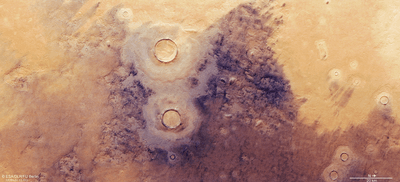


China's Zhurong rover was the first Chinese mission to land on Mars, exploring one of the Red Planet’s largest impact basins: Utopia Planitia. This area was first visited by Viking 2 in 1976 and thanks to decades of technological advancement, Zhurong has delivered new insights into the planet's make-up. It turns out, the rover found 16 polygonal structures buried beneath the Martian surface.
The formation was discovered 35 meters (115 feet) underground using Zhurong's ground penetratingradar. Scientists believe these polygons were formed by freeze-thaw cycles that led to the formation of cracks in the terrain, which was originally on the surface. As seen in other areas on Mars, sublimation and freezing can carve the terrain in peculiar ways; just look at the so-called spiders on Mars. This process may have been going on for billions of years.
Previous work has focused on the vertical layers of the region, which indicate that there have been several episodic floods that filled the basin, roughly around 3 billion years ago. The new study uncovered what the layers are like horizontally by looking at the radar analysis across the 1.9 kilometers (1.2 miles).

Mars used to be a volcanic world: the tallest volcano in the Solar System is on Mars. Some geological activity persists to this day, with marsquakes recorded on the Red Planet by NASA’s InSight.
So, the researchers considered the possibility that the buried structure had a lava origin. On Earth, there are several examples of these, such as the Giant's Causeway. However, there was no evidence of basaltic extrusions where Zhurong had explored. The team is confident that the structures are sedimentary, formed from thermal processes in varying climates.
And that’s an intriguing consequence of this study. If the polygonal structures required freezing-and-thawing events, the climate of ancient Mars ought to have been a lot more variable. Utopia Planitia is at low-to-mid latitudes. The area is 25 degrees north of the Martian equator. But the planet might have had had a higher obliquity, so the region might have experienced wildly different seasons.
The layers indicate more has happened in the past. The polygonal structures were buried in layers of material that look nothing like them. Maybe the wet environment that formed them stopped existing, or some other unknown geological event took place.
“Occurring at low latitudes (∼25° N), the polygonal terrain, which is interpreted as having most likely formed by thermal contraction cracking, makes a compelling case for the high obliquity of early Mars. The subsurface structure with the covering materials overlying the buried palaeo-polygonal terrain suggests that there was a notable palaeoclimatic transformation some time thereafter,” the authors wrote.
The study is published in Nature Astronomy.



 1
1