Nature
 PUBLISHED
 29
29


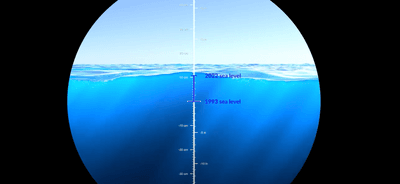


You often hear facts and figures about sea level rise, but it's not always easy to imagine how it’s already reshaping the planet we live on. This beautifully aminated visualization by NASA clearly how shows the sea level of the world’s oceans has significantly risen in recent decades – with little sign of stopping soon.
Created by NASA’s Scientific Visualization Studio, the animation is seen from the perspective of a boat’s porthole bumping into the waves out at sea. As the years trickle by, the sea level slowly but surely rises.
It documents to change in global sea level from 1993, when satellites started making a reliable record of the change, right up until 2022. The short blurb of the video explains: “When played on a 4K 85" display, the measurement markings in the video are accurate to the real world.”
Between 1993 and February 2023, the global average sea level rose 9.85 centimeters (3.8 inches). While that might sound subtle, NASA says that it is “unprecedented over the past 2,500-plus years”.
Make no mistake, there’s little debate over what’s driving this change: human-driven climate change.
The climate crisis increases sea levels in a few different ways. Firstly, as heat is absorbed by the oceans, the water expands. Secondly, vast quantities of water that previously were stored as ice in Greenland and Antarctica's ice sheets are thawing at a shocking rate, turning into liquid and filling the oceans. Last but not least, melting mountain glaciers are also contributing considerably.
The impact of these changes will be profound. Coastal regions and low-lying areas will take much of the initial burden, but rising sea levels also have the potential to allow storm surges and floods to reach farther inland. This will have a devastating impact on a huge number of human settlements around the world, let alone natural environments.