Nature
 PUBLISHED


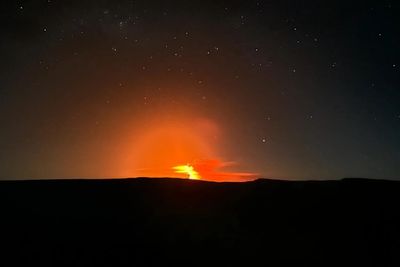


If someone says “Galápagos Islands”, it often conjures up thoughts of giant tortoises or Charles Darwin – but there’s something important missing from that list. The islands are volcanic, and they’ve just dished up a steaming hot reminder of that with the eruption of La Cumbre volcano late on Saturday night.
La Cumbre, a shield volcano found on Fernandina Island, began erupting on March 2 at around 11:50 pm local time. Lava began to flow from the fissure in the volcano’s southeastern flank, lighting up the night sky, whilst a gas cloud shot up an estimated 2 to 3 kilometers above the summit.
Though the eruption is yet to conclude, Ecuador’s Geophysical Institute has reported that it’s likely to be larger than the eruptions of La Cumbre observed in 2017, 2018, and the most recent eruption in 2020. Seismic activity in the area gradually increased since then, indicating a build-up of magma that eventually escaped in the current eruption.
However, the island of Fernandina is no stranger to eruptions. In fact, its resident lava spout gives off pretty strong toddler vibes; though it’s the youngest of the Galápagos volcanoes, La Cumbre has recorded between 28 to 30 eruptions since 1800, giving it the highest temper tantrum eruption recurrence rate in the archipelago.
Thankfully the island is uninhabited – at least by humans. “But what about the animals?!” we hear you cry, which is understandable considering the island is home to a whole host of unique creatures. Whilst we imagine at least some of them got unwittingly killed (RIP), according to the charity Galápagos Conservancy, the current eruption doesn’t pose “a significant immediate threat to any Galápagos wildlife”.
However, eruptions aren’t precisely predictable, meaning there is potential for the situation to change. One resident in particular on some people’s minds is a giant Galápagos tortoise by the name of Fernanda, a member of a species thought to have gone extinct due to volcanic activity. She was the first to be seen in 113 years.
La Cumbre’s youthful level of activity presents a problem for tortoise survival, as Adalgisa Caccone, a senior research scientist and lecturer in Yale’s Department of Ecology & Evolutionary Biology, told IFLScience in 2022.
"What that has done is constantly create new lava fields that are very difficult to pass,” said Caccone. “Even for humans to explore properly is really difficult, but for the tortoises it’s created isolated patches of suitable habitats so they can’t go from one place to the other.”
Let’s hope the elusive giant is tucked away safe and sound from this latest eruption.

 1
1