Ad

nature-iconNaturenature-iconenvironment
clock-iconPUBLISHEDAugust 15, 2022
comments icon1
share450

Spectacular Flying-Saucer Cloud Seen On Top Of Mauna Kea

The peculiar phenomenon is called lenticular cloud and it is seen sometimes over the top of mountains.

Dr. Alfredo Carpineti headshot

Dr. Alfredo Carpineti

Alfredo has a PhD in Astrophysics and a Master's in Quantum Fields and Fundamental Forces from Imperial College London.

Space & Physics Editor

Alfredo has a PhD in Astrophysics and a Master's in Quantum Fields and Fundamental Forces from Imperial College London.View full profile

Alfredo has a PhD in Astrophysics and a Master's in Quantum Fields and Fundamental Forces from Imperial College London.

View full profile
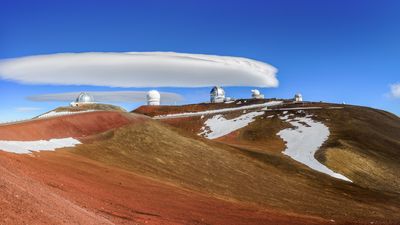
The lenticular cloud on top of Mauna Kea. Image Credit: International Gemini Observatory/NOIRLab/NSF/AURA/J. Chu

The National Science Foundation’s NOIRLab has shared a great picture of the sky behind the Gemini North Observatory which is located in Maunakea, Hawai’i. The dominant feature is a white large looming cloud, which the team jokes is not a flying saucer.

The rest of this article is behind a paywall. Please sign in or subscribe to access the full content.

So not aliens, but a perfectly natural phenomenon known as lenticular cloud. Lenticular means lens-like and you can see why the term is used. These clouds are usually seen around mountains and peaks. You need high, humid winds blustering over mountainous terrain – of which Mauna Kea is an excellent example of being 4,207 meters (13,802 feet) above sea level. 

When the humid winds pass over the mountain, the air cools down and with rising altitude there is lower pressure, making this combo an ideal place for water droplets that make a cloud to form. High-altitude air continues to flow while the lower altitude air rush up the mountain to make the cloud. As they meet when the cloud forms, it is carved in the lens-like shape that we see. 


Add us as a Google preferred source to see more of our
trusted coverage in Search