Nature
 PUBLISHED
 1
1


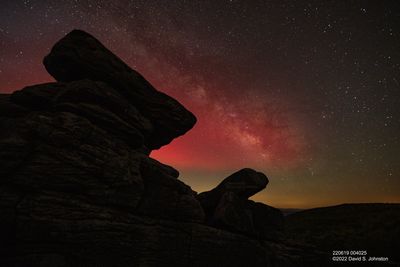


In the small hours of Sunday morning, patient night photographers struck gold by capturing an image of an other-worldly red glow darting across the galaxy. The culprit, they suspect, was a SpaceX rocket that launched just minutes before in Florida.
Photographer David S Johnston captured the shot of the red-tinted sky while taking long-exposure photographs of the Milky Way at 12:30 am on June 19 in Bear Rocks, West Virginia.
The red color in the sky was not visible to the naked eye, but after Johnston looked back at his photos, it was clear the camera picked up on something special.
“I had no idea what this was and it was kind of freaking me out,” Johnston wrote in a Facebook post.
“I showed the pictures to some people this morning and a friend, perhaps half in jest, suggested it could have been a rocket launch. But I did look into it, and sure enough, SpaceX launched a Falcon 9 with a Globalstar satellite payload from Florida at 12:27 am, just a few minutes before the red appeared,” he added.

Johnston isn't alone in suspecting the rocket blast created the stunning scene. Similar images were snapped in Maryland, North Carolina, and elsewhere with many other photographers reaching the same conclusion, while some scientists also agree the SpaceX rocket explanation might be onto something.
Carlos Martinis from the Center for Space Physics at Boston University explained to the Washington Post that the red glow may be linked to the engine burn of the Falcon 9′s second stage, which typically starts about three minutes after lift-off at an altitude when positive oxygen ions are present in the atmosphere. Fuelled by the intense rocket engine burns, the oxygen ions are encouraged to combine with other ambient molecules and form molecular O2+, N2+, and NO+ ions, which react with electrons and produce a glow.
Alternatively, Tamitha Skov, a space weather expert, told the newspaper that the image may have picked up on a "sub-visual aurora.”

In the Northern Hemisphere, the aurora borealis is the product of electrically charged particles from the Sun’s corona clashing with Earth’s magnetosphere. The collision releases energy, exciting gases in our upper atmosphere and causing causes ionization of the atmospheric molecules. The reaction also generates light, with oxygen ions producing green and yellow light, and nitrogen creating red or blue light.
A similar phenomenon may be behind the eerie red sky recently seen in the US, suggests Skov.
Whatever the explanation, we can all agree it made for some beautiful photography.
“I can't believe I had my camera pointed in exactly the right direction and was actively shooting at just the right time!” Johnston said in his post.