Space and Physics
 PUBLISHED


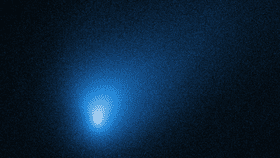


Comet 2I/Borisov, discovered last summer, is the first interstellar comet ever detected in the Solar System. It came from another star and went for a fateful trek through our corner of the galaxy. Researchers have been understandably fascinated by this interstellar visitor, trying to understand how different it is from the comets in our own Solar System.
Previous studies have highlighted both similarities and differences. Now, a new piece of research published in The Astrophysical Journal Letters provides a wider approach to this discussion. Researchers tracked the water loss of Borisov as it made its closest approach to the Sun, and while it suggests the comet is not truly a bizarre object, it also doesn’t belong with any known families of comets in the Solar System.
“Borisov doesn't fit neatly into any class of Solar System comets, but it also doesn’t stand out exceptionally from them,” lead author Zexi Xing, a graduate student at the University of Hong Kong and Auburn University in Alabama, said in a statement. “There are known comets that share at least one of its properties.”
Comet Borisov has certainly a lot in common with comets in the Solar System. Several chemicals were found in similar quantities on this interstellar visitor, and the level of water production as it got closer to the Sun was in line with predictions from homegrown comets. All comets are small icy bodies made up of frozen gases, rock, and dust, that – in our Solar System at least – orbit the Sun. When a comet's orbit takes it close to the Sun, the heat melts the ice and it fragments, spewing out gas and dust, creating a gaseous tail as the comet continues on its journey.
Borisov reached the closest point to the Sun on December 8 and at peak activity 55 percent of its surface (about the area of Central Park) was active. It released 30 liters (8 gallons) of water per second, about enough to fill a bathtub in 10 seconds. Its journey through the Solar System cost the comet 230 million liters (61 million gallons) of water.
Borisov's active area is about 10 times larger than what we've seen in comets from our Solar System. Another peculiar difference is the level of activity suddenly dropped off as the comet moved away from the Sun; a change much more sudden than in previously observed objects. This could have been caused by a variety of factors, including the fact that it began breaking apart. Adding the high level of carbon monoxide seen in two recent studies, Borisov is certainly something different.
How this object fits with our general idea of comets is not at all obvious. The discovery of Comet 2I/Borisov, by amateur astronomer Gennady Borisov on August 30, 2019, is a pivotal point in our understanding of these minor planets in the Solar System and beyond.