Space and Physics
 PUBLISHED


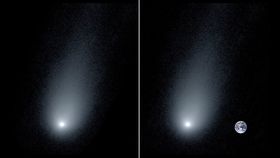


Currently zipping across the Solar System is an object that wasn’t formed around the Sun. This unexpected interstellar visitor is the first identified comet that originates from another star, and astronomers at Yale have taken a new exciting close-up of it.
Its full title is 2I/Borisov; 2I because it’s the second interstellar object discovered after ‘Oumuamua in 2017, and Borisov after Gennady Borisov, the Crimean astronomer who discovered it on August 30 of this year. The comet is currently getting closer to the Sun. It will reach its closest point on December 8, when it will be roughly 300 million kilometers (190 million miles) away.
Observations of the comet over the last few months have shown that 2I/Borisov is remarkably similar to comets from our Solar System. It's also becoming more active. As it gets closer and closer to the Sun, its tail has stretched considerably, now reaching nearly 160,000 kilometers (100,000 miles) in length. That’s 14 times the size of our planet.
“It’s humbling to realize how small Earth is next to this visitor from another Solar System,” Pieter van Dokkum, one of the scientists who captured the new image, said in a statement.
Comets are mostly composed of ice. As they get closer to the Sun (or any star for that matter), the ice sublimates (goes from a solid to a gas) and the comet develops a tail. Observations have shown that the nucleus of Borisov is about 1 kilometer (0.6 miles), so it really puts into perspective just how far the tail extends.
The days around the closest approach to the Sun are ideal for studying the comet due to its closeness and its activity. Van Dokkum and his colleagues Cheng-Han Hsieh, Shany Danieli, and Gregory Laughlin used the W.M. Keck Observatory in Hawaii to take this image on November 24, with more sure to come.
“Astronomers are taking advantage of Borisov’s visit, using telescopes such as Keck to obtain information about the building blocks of planets in systems other than our own,” Laughlin said.
Observations of the comet are continuously taking place as the interstellar visitor hurtles through the Solar System at the incredible speed of 150,000 kilometers (93,000 miles) per hour. The comet will remain visible for many months so astronomers will continue to track it well into 2020.