Space and Physics
 PUBLISHED


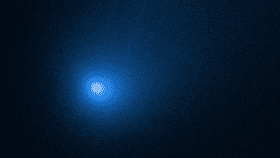


At the end of August 2019, Crimean astronomer Gennady Borisov discovered the first known interstellar comet. The object whizzed through the Solar System getting brighter and brighter as it got closer to the Sun, making its closest pass in early December. Reports now suggest that Comet 2I/Borisov is experiencing outbursts, which suggests it may be breaking apart on its way out.
In a post on The Astronomer’s Telegram, Polish Astronomers using the Optical Gravitational Lensing Experiment (OGLE) report the detection of two major outburst events. The first one happened between March 4 and March 5, with the brightness of the comet remaining stable for a few days. A second brightening event happened on March 8, the brightness stabilizing again over the following days.
“This behavior is strongly indicative of an ongoing nucleus fragmentation,” the researchers write in The Astronomer’s Telegram.
Comets are "dirty snowballs", small icy bodies made up of frozen gases, rock, and dust, that – in our Solar System at least – orbit the Sun. When a comet's orbit takes it close to the Sun, the heat melts the ice and it fragments, spewing out gas and dust, creating a gaseous tail as the comet continues on its journey. Many comets in the Solar System actually experience fragmentation events on a regular basis, before merging back together. Comet Borisov may not be from our Solar System, but its behavior is very similar to our local comets, so it's likely this is what is happening.
Comet Borisov is the second interstellar object discovered crossing the Solar System, but the first comet. Asteroid ‘Oumuamua first passed through our cosmic neck of the woods in 2017. Astronomers believe many more objects from other star systems are passing through ours at any one time, but most of them are too faint for us to see.
Astronomers will continue to monitor this object, although observations may be a bit difficult right now – not just because of the current physical distancing situation in place in many countries, but also because the comet is in front of the bulk of the stars of the Milky Way, so may get lost amongst their brightness. The comet should still be visible for a few more months though, so ground and space observatories will hopefully be able to confirm or deny if fragmentation actually happened.
[H/T: New Scientist]