Nature
 PUBLISHED


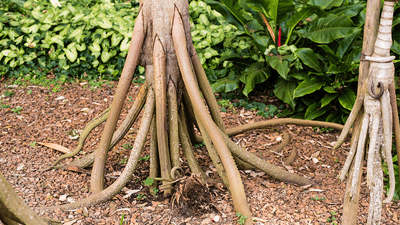


Socratea exorrhiza, more commonly known as the "walking palm", is certainly a weird-looking tree. With unusual "stilt roots" that stick up out of the ground, they have even been the subject of a hypothesis that they can "walk" around the rainforests of Central and South America where they are found.
The origins of the "walking palm" idea goes back to a paper published in 1980, and an attempt to explain why these stilt roots often keep the base of the trunk elevated above the ground by over a meter (3.3 feet).
Previous explanations had it that the odd-looking roots helped the trees to deal with flooding, keeping them above the water. Whilst this explanation is not necessarily correct, it is a little better than the popular explanation that took off thanks to the 1980 paper.
"During an intensive field study of palm cultural ecology in eastern Peru we observed that the stilt roots of Socratea exorrhiza allow seedlings and juveniles that are flattened by falling trees, limbs, or palm fronds to right themselves and 'walk' out from under the obstacle," the paper explains, carefully adding:
"We apply the term 'walking' to these phenomena because of the leg-like action of the stilts, and because the plant eventually straightens itself at a new location, but we do not mean to attribute purpose to the plants."
While the team did not suggest that the trees were walking around like the Ents of Middle-Earth, or Bill Bryson on a book deadline, they did suggest that the trees were a lot more mobile than trees are known for.
"The special significance of the stilts is that they allow a tree to establish itself at some distance from its original germination point because the oldest roots and lower trunk are left behind as they are broken or rot away," the team explained, making it sound a lot less like walking. Getting to the shops would be a lot more difficult if you had to wait for your trailing leg to drop off, for example, though it might be useful for a tree in order to escape an area of heavy competition, or reach towards a patch of sunshine.
The team also suggested that the stilt roots help juvenile trees to right themselves after they fall, with the roots seeking out the soil and slowly lifting the tree back up again.
It's a fun idea, and you can see why people would like to believe that there are trees out there, kind of walking through the rainforest, or at least being more mobile than the rest of those lazy (e.g.) conifers. It's also clear why tour guides in the area might perpetuate the myth, given how zany the idea is.
But nobody has seen this action in person, and further studies have thoroughly debunked this odd (but fun) idea.
In 2005, one study led by Gerardo Avalos, now director of the Center for Sustainable Development Studies in Atenas, Costa Rica, and one of the leading experts on the "walking palm", found that the tree's roots do not move at all, let alone the 20 meters a year (66 feet) often claimed around the Internet.
"My paper proves that the belief of the walking palm is just a myth," Avalos told Life's Little Mysteries, per Live Science. "Thinking that a palm tree could actually track canopy light changes by moving slowly over the forest floor... is a myth that tourist guides find amusing to tell visitors to the rainforest."
More recent studies have found better explanations for the odd-looking roots, which don't involve it trying to escape from flooding, either.
"We found positive relationships between allocation to vertical growth and stilt root architecture including root cone circumference, number of roots, and root cone volume," a 2007 study found.
"Accordingly, stilt roots may allow S. exorrhiza to increase height and maintain mechanical stability without having to concurrently invest in increased stem diameter and underground root structure. This strategy likely increases the species ability to rapidly exploit light gaps as compared to non-stilt root palms and may also enhance survival as mature trees approach the theoretical limits of their mechanical stability."
In short, as you probably suspected all along, trees are unable to walk outside of Middle Earth and the Guardians of the Galaxy franchise, as far as we are aware.