Health and Medicine
 PUBLISHED
 2
2


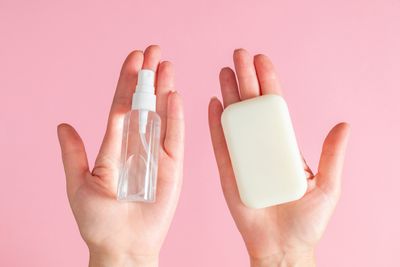


The winter season is pretty much an exercise in dodging all the colds, flu, norovirus, and other microbial assailants out to ruin your day (please note: summer illnesses are also available). Two of the key weapons we have at our disposal in this relentless fight are soap and hand sanitizer, but when should we deploy them? Can hand sanitizer ever truly replace soap? Here’s everything you need to know.
What’s in hand sanitizer?
The main ingredient in most hand sanitizer formulations is alcohol, and lots of it.
“Many studies have found that sanitizers with an alcohol concentration between 60-95 percent are more effective at killing germs than those with a lower alcohol concentration or non-alcohol-based hand sanitizers,” the Centers for Disease Control and Prevention says.
You may also see some alcohol-free sanitizers that contain an antimicrobial ingredient such as chlorhexidine, but these tend to be seen more often in healthcare settings. For regular everyday use, 60 percent alcohol is the magic number to look out for.
How does hand sanitizer work?
A 2020 study took a deep dive into how hand sanitizers work against different pathogens – and if you recall what was happening in 2020, you’ll see why there was so much interest in this topic!
With bacteria, it’s likely alcohol works by damaging their membranes or interfering with cellular processes like protein synthesis. “Water is […] critical in the protein denaturation process,” the paper notes, which is why you need your alcohol to be at least slightly diluted, and you can’t just slap 100 percent ethanol all over your hands and call it done.
For viruses, alcohol is known to target the protective outer layer called the envelope. Without this intact, the vital internal machinery and genetic material within the virus particle is vulnerable, and the virus can’t replicate.
But this is where we run into a problem. Not every virus is enveloped. SARS-CoV-2 is, which is why sanitizers work pretty well to help stop transmission of COVID-19 via surfaces, but norovirus, for example, is not.
For non-enveloped viruses, we need to go back to a much more old-school method: good, old-fashioned soap and water.
How does soap work?
Washing with soap and water can be thought of as a multi-pronged attack on germs.
As UCI Health explains, “soap molecules, themselves, are very effective at destroying the surface membranes of some bacteria and viruses […] In addition, the lathering of hands and scrubbing thoroughly creates friction that helps lift and wash away dirt, grease and microbes under running water.”
The act of lathering up our hands with a nice-smelling soap feels therapeutic to us, but it’s a brutal death sentence for viruses and bacteria.
Soap molecules are a combination of a hydrophilic – or water-loving – head and a hydrophobic tail, which prefers to bond with oils and fats. When you wash your hands, these molecules surround any microbes that may be present on the skin.
The hydrophobic parts of soap molecules will do anything they can to get away from water. With enveloped microbes, that looks like the soap molecules essentially wedging themselves into the envelope and causing it to break apart.
“They act like crowbars and destabilize the whole system,” Professor Pall Thordarson of the University of New South Wales told the Yale School of Medicine.
At the same time, soap molecules disrupt the bonds that attach microbes to our skin, allowing them to be washed away.
Soap molecules can also club together into structures called micelles, with their hydrophobic tails pointing inwards and their hydrophilic heads pointing outwards. These structures are very effective at capturing particles of dirt and pathogens, allowing them to be washed away. It’s why micellar water facial cleansers work so well.
All soaps work this way – you don’t need to splash out on ones with fancy added “antibacterial” ingredients. Soaps and soap substitutes that contain ingredients like benzalkonium chloride may be necessary in some medical settings or be prescribed for the management of certain health conditions, but for regular handwashing, any soap you can pick up at the drugstore or grocery store – bar or liquid – will do.
“There’s no data demonstrating that [antibacterial soaps] provide additional protection from diseases and infections. Using these products might give people a false sense of security,” said the Food and Drug Administration’s Theresa M. Michele, M.D., in a 2024 consumer update.
Which is better: soap or sanitizer?
There’s really no replacement for simple soap and water. If you can’t access running water or soap, using hand sanitizer is better than nothing – but soap is cheap, it’s easy, and it works better than any more hi-tech solution humanity has so far come up with.
As we’ve seen, hand sanitizers are mainly effective for enveloped pathogens, but soap works across the board. As well as that, soap effectively cleans away dirt that you can see. Sanitizers aren’t as effective when your hands are visibly dirty.
There is one caveat: it’s important that you are handwashing with the proper technique to get the most out of your soap.
Remember in 2020 when everyone was talking about singing Happy Birthday while washing your hands? There was actually something to that – you should be scrubbing for at least 20 seconds. Yes, every time.
And don’t skip the drying either: “moist hands are much more likely to pick up microbes from a surface,” wrote Joe Schwarcz, PhD, for the McGill University Office for Science and Society.
“Following simple handwashing practices is one of the most effective ways to prevent the spread of many types of infection and illness at home, at school and elsewhere. We can’t advise this enough. It’s simple, and it works,” said Michele.
All “explainer” articles are confirmed by fact checkers to be correct at time of publishing. Text, images, and links may be edited, removed, or added to at a later date to keep information current.