Space and Physics
 PUBLISHED




With the Paris 2024 Olympics in full swing, people have a number of questions about sports you only really see every four years or so.
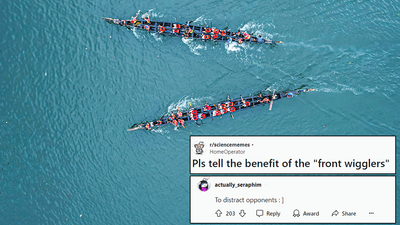
While fencing has people asking why on Earth the competitors are attached to metal cables, people have been sharing old footage of an unusual boat race. While the racers achieve impressive speed in their oar boat, people have a lot of questions about why the team includes four or five people at the front thrusting their groins at the boat.
Several people on Reddit, where the footage had resurfaced over the years, had theories about what the "humpsmen" are doing.
Some noted a similarity to dragon boats and Vallam kali, a traditional kind of snake boat racing from Kerala, India using a beaked boat called a chundan vallam. In Vallam kali, the front competitors are similarly out of the water, and their weight helps keep the front portion from lifting too much out of the water, helping to steady it. However, they use long oars to reach the water and generate thrust, whilst also setting the pace for the rowers behind.
There are many variations of boat races around the world, and though the rowers in the clip appear to be using a snake boat it's not altogether clear what variation of boat they are using. It does appear that the "humpsmen" are providing the rhythm for the oarsmen behind to follow. Some suggested that they are there to keep the boat out of the water whilst the oarsman push it forward. However, the team in front is moving much faster with more surface contact, spreading the weight along the surface of the water more evenly.
Spreading the weight along the boat is a tactic employed in rowing, and the unorthodox method employed here would help with that by keeping the boat touching the water, attempting to counterbalance the lift caused by the weight and movement of the rowers behind. Timing the thrusts to keep the boat low as the force is applied from behind would also keep the force going in the right direction; forward, instead of up. If the boat is bobbing up and down, you aren't traveling in the most efficient way, just like in your car.
However, as in Vallam kali and rowing, there are other ways of weighting boats for maximum efficiency. And with a wide variety of boats available and already widespread around the world, don't expect to see the boat wigglers at the Olympics any time soon.