Culture and Society
 PUBLISHED
 1
1


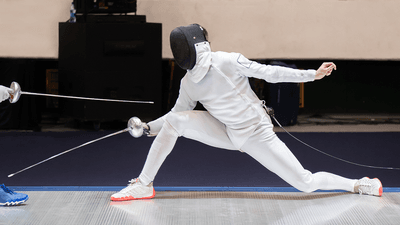


If you're watching the Olympics, you may have noticed that fencers are attached to a cable, making them look somewhat like they're on a big leash.
The cables are not there for the safety of the competitors, nor so that they can be yoinked backwards if they get too feisty. The cables, which are electric, are there because of how quick the sport is. Here is a clip of Egypt's Nada Hafez – competing while seven months pregnant for extra difficulty – to show you how fast the sport is.
With the sport being so fast-paced, it is difficult to determine whether there was a hit, who hit who first, and whether they were hit in a legitimate target area. The early days of fencing relied on honesty from competitors, who would shout touché after being hit, as well as judges to determine who hit first. But that wasn't ideal.
In 1896, a solution was reported; a hit completing an electric circuit to alert judges when a competitor had been hit. This is where the cable comes in.
"They connect your weapon (your foil, sabre, or épée) to the reel system. and the scoring system in the club or venue where you're fencing," Coach Michael McTigue of the Northwest Fencing Center explained in a YouTube video. "They have a kind of hard job to do, because they need to be flexible and moving and yet out of your way; they need to be reliable and yet they need to be light."
In different types of fencing, there are different requirements for competitors, depending on what the target is. Épée was the first type to use the electric scoring system, as the whole body is a target, requiring only a simple setup.
"As the whole body is a target in Epee, a non-electric fencing mask is used for competition epee fencing," Fencer Tips explains. "At your local fencing club, a lot of the communal masks are likely to be non-electric masks or epee masks, regardless of your weapon of choice, as they are used for teaching purposes outside of electric fencing."
But other types of fencing have areas of the body that are off target, which means that hitting them does not count as a proper hit. For this, electrically-conducive metals are woven into fabric in the target areas. In sabre fencing, fencers also wear a conductive mask.
"A sabre mask is completely conductive, making sure that any touches are registered on the scoring apparatus," Fencer Tips explains. "This is in line with the target area for sabre, which is the above-the-waist torso, the arms, and the head."
It took a long time for the electric scoring system to be fully adopted. Electric sabre fencing, where hits from the blade as well as the tip are allowed, was not widespread until the 1992 Olympic Games in Barcelona. But now when you watch fencing, at least at a competitive level, you will see people competing with a metal tether.
All “explainer” articles are confirmed by fact checkers to be correct at time of publishing. Text, images, and links may be edited, removed, or added to at a later date to keep information current.