Nature
 PUBLISHED


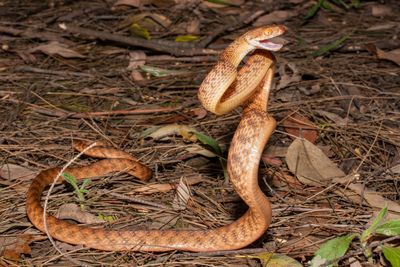


Scientists have resolved a biological mystery, the question of how snakes – particularly tree snakes – manage to hold such large portions of their bodies upright without limbs. The work could contribute to advances in robotics, particularly robots made unbranching so they can slither through exceptionally small holes.
Limbs are so important for most land animals that it’s a constant puzzle why some snakes not only evolved to do without them, but flourished thereafter. Clearly, getting legless has done snakes no harm, as demonstrated by the fact that some of them seem to be better at standing upright than many quadrupeds.
Harvard Professor L Mahadevan realized that keeping 70 percent of one’s body vertical, without something to lean against, is not just a muscular problem, but one of balance. It takes remarkable proprioceptive feedback – the capacity to sense where parts of one’s body are. To explore how snakes do it, Mahadevan brought together a very multi-disciplinary team.
“For some it may be the stuff of nightmares, but we’ve now analyzed, mathematically and physically, the hidden physics and control strategies that allow snakes to defy gravity,” Mahadevan said in a statement.
The work could prove applicable for snake-like robots such as the one NASA has demonstrated as a possible explorer for Europa and other icy moons. Even medical devices may make use of the lessons, the team hope. “By concentrating control where it counts, engineers may learn to build machines that are both efficient and resilient,” said first author Dr Ludwig Hoffmann.
The capacity to rear up prior to striking exists across the serpentes suborder, sea snakes possibly aside, but it’s arboreal snakes that have developed it to a fine art for a different purpose. It’s one thing to be able to get vertical with the support of a tree, but tree snakes also need to be able to move from branch to branch, going up as well as down. Brown tree snakes can hold more than two-thirds of their body in the air to do this, as can juvenile pythons.
The team filmed three brown tree snakes (Boiga irregularis) and one scrub python (Simalia amesthistina) climbing between various platforms made thin enough the snakes could grip them.
Cameras capable of observing serpentine movements in detail revealed that the snakes do not stiffen their whole body, as we might expect, but instead create a region near the base they are rising from, where the muscle force is concentrated. As long as the body above this “boundary layer” is almost vertical, gravity does not apply torque, i.e., pull the front part of the snake downwards in any direction.
The body itself does the job of preventing the snake from collapsing directly down. However, this only works as long as the snake keeps a posture that would make a Victorian deportment teacher weep with pride. Maintaining this stability for any length of time is actually much more demanding than the snake lifting most of its body in the first place, modeling revealed. “It is stability that limits the maximal standing height,” the authors state, although they acknowledge that more measurements are required to prove this.
Although from a muscular perspective the boundary layer is a very efficient approach, it relies on excellent proprioception, as whenever the snake starts to fall in any direction, it needs to recognize this and pull itself back. The authors note evidence that some snakes can hold themselves vertical in the dark, suggesting vision may not be essential.
Even when suitably balanced, snakes need to know which muscles to flex. The team explored two mathematical models of how this could be done, one using local stiffening and the other coordinating throughout the whole body. The whole body coordination is theoretically far more efficient in terms of effort. Even with that efficiency, however, the constant swaying seen in snakes when their bodies are extended past a point they can easily maintain shows the operation is not easy.
The study is published in The Royal Society Interface.