Humans
 PUBLISHED

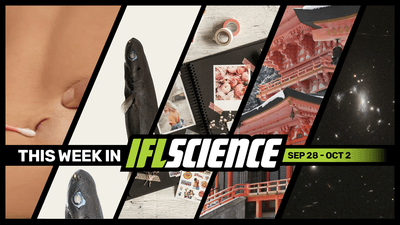


This week, a newly discovered 20-centimeter-long lanternshark could be the world’s smallest shark species, scientists have studied a teenager with one of the rarest memory abilities humans can have, and Supernova Athena will appear any day between now and March 2027. Finally, we spoke to the makers of AFRICA: Earth’s Wild Home, NatGeo’s new series, to find out about the world’s smallest crocodile and other never-before-seen animal behavior.
Create an IFLScience account to get all the biggest science news delivered straight to your inbox every Wednesday and Saturday.
Smelly Belly Buttons Could Suggest Whether People Have Parkinson’s Disease
A small handful of people have a dog-like ability to smell Parkinson's disease in other people, but for those of us without that superpower, machines may be able to pick up the faint scents instead. And it turns out the belly button might be a good place to start. Read the full story here
New Species Of Teeny Tiny Lanternshark Looks Shocked To Have Been Discovered And Could Be A World's Smallest Shark Contender
Deep in the waters of Mauritius in the southwest Indian Ocean lives a newly discovered species of lanternshark. These tiny sharks are mysterious, living cryptic lives with very little known about their ecology. For instance, why does this new species have a particularly large nose? It's even been named Etmopterus bulbosus thanks to what the researchers call its “large bulbous snout”. Read the full story here
Scientists Studied A Teenager With One Of The Rarest Memory Abilities Humans Can Have. Here’s What They Found
Remembering what you had for dinner last night, or why you entered the room you just walked into, can be a tricky task, so imagine what it would be like to recall any given day in your past at the drop of a hat. People with highly superior autobiographical memory (HSAM) don’t have to imagine; they possess the incredible ability to access memories from their own lives with ease, even decades later. Read the full story here
Monk Starts 12 Years Of Isolation At A Buddhist Temple: What Can Severe Isolation Do To The Human Mind?
You may have seen in the news that Sogaku Taguchi, a 31-year-old Tendai Buddhist monk, has started a 12-year period of total seclusion at the Enryaku-ji temple complex on Mount Hiei, overlooking Kyoto in Japan. What happens to the mind of a monk who chooses 12 years of isolation? Scientific literature has plenty to say on the matter, and some of it may surprise you. Read the full story here
Supernova Athena Is About To Return – And You Can Warn Your Grandkids About Supernova Ares
Supernovae are, as far as we know, unpredictable. Occasionally a star goes boom in a galaxy near or far. There is an exception to the rule, though, and humanity is about to see a star going supernova anytime from now to the next few months. We have a peculiar warning sign that this is going to happen: we have seen this star explode before. Read the full story here
TWIS is published weekly on our Linkedin page, join us there for even more content.
Feature of the week:
The World’s Smallest Crocodile Lives In A Cave, With Orange Skin So Thin You Can See Its Skeleton – Life In “AFRICA: Earth’s Wild Home”
National Geographic’s new series AFRICA: Earth’s Wild Home is bringing one of the most beautiful and biodiverse parts of the world to our screens this fall. Packed full of first-time footage, it reveals ecosystems and animal behaviors that have stayed hidden until now, including some truly bizarre reptiles. We spoke to the makers and a narrator of the series to find out more. Read the full story here
More content:
Meet the Author: In our exclusive CURIOUS interview and excerpt, meet astrobiologist and author Dr Seven M. Rasmussen and read an excerpt of her new book Cloudy With A Chance Of Starships, in which she reveals where she would search for life in the Solar System.
To access exclusive CURIOUS content first and receive the quarterly digital magazine, become an All Access Member.
PLUS, the We Have Questions podcast – an audio version of our coveted CURIOUS e-magazine column – continues. In episode 25, we ask, “Why Do Hammerhead Sharks Have Hammer-Shaped Heads?”
The Big Questions podcast continues as we ask, “Just How Queer Is The Natural World?” Host Eleanor Higgs speaks to Josh Luke Davis, author of A Little Gay Natural History, to find out more about one of the more controversial zoological topics.


 1
1