Health and Medicine
 PUBLISHED





A small handful of people have a dog-like ability to smell Parkinson's disease in other people, but for those of us without that superpower, machines may be able to pick up the faint scents instead. And it turns out the belly button might be a good place to start.
A new study tested out a new way to detect different medical conditions based on the tiny airborne compounds that float around and spark our sense of smell, known as volatile organic compounds (VOCs).
To start, scientists at Dresden University of Technology and the Fraunhofer Institute for Integrated Circuits IIS in Germany swabbed the nose, navel, and ear of 24 patients, including six with Parkinson’s disease, six with mild cognitive impairment, six with COVID-19 infection, and a final six with no known health problems.
Lasers reveal the chemical fingerprint of smells
The odor from the cotton swabs was then analyzed using laser-based photoacoustic spectroscopy.
This involves a high-tech piece of equipment that shines a laser onto the air around the swab. The wafting odor molecules absorb the light, creating tiny sound waves that are picked up by an extremely sensitive detector. Each mix of molecules produces its own pattern of sounds, like a chemical fingerprint.
The researchers analyzed the results and were able to cluster four groups of people – healthy people, Parkinson's patients, COVID-19 patients, and people with mild cognitive impairment each give off subtly different VOC patterns.
The nose and navel swabs gave the clearest results, while the ear swab was a bit more vague.
However, there was some blurry overlap with the clusters, meaning the difference between diseases was not clear-cut.
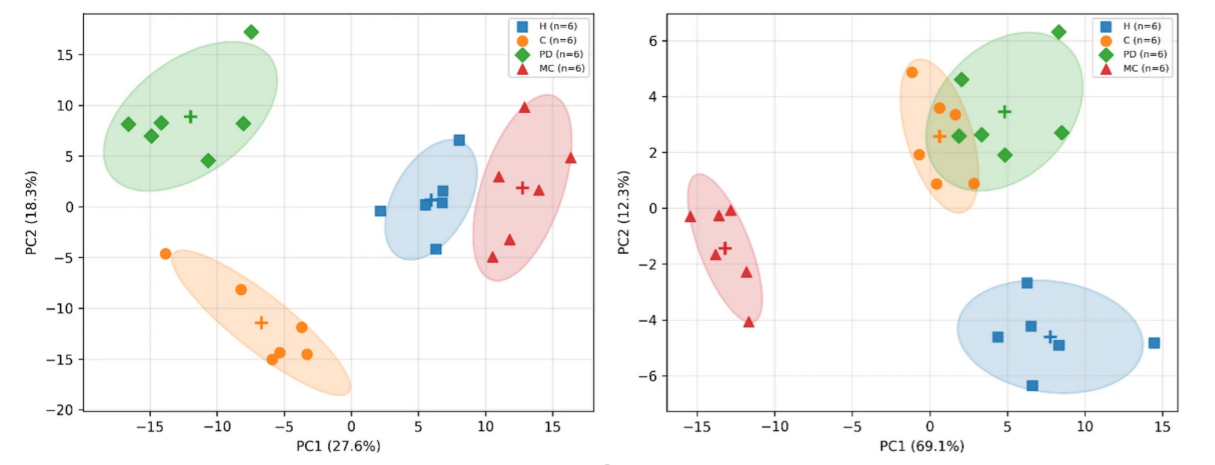
To clarify their results, the researchers added three new Parkinson's samples into the mix. These fit in with the original Parkinson's cluster, which suggests the initial results weren't a mere fluke.
However, there were some major limitations to the study. Parkinson's and cognitive impairment primarily affect older people, so it’s possible that the method is actually sniffing out a general sense of infirmity and aging, rather than a specific disease.
Since the sample size was so small, it’s difficult to rule out this possibility.
Smells, dogs, and Joy Milne
With those caveats in mind, it is becoming increasingly well-established that bodily odors are closely associated with Parkinson’s disease.
Other studies have shown that dogs are incredibly effective at using their finely tuned sense of smell to identify people with Parkinson’s.
There is even one woman, a retired Scottish nurse named Joy Milne, who has the superpower of sniffing out Parkinson’s disease. One day, she noticed her husband’s body odor had become increasingly musky. Six years later, he was diagnosed with Parkinson’s disease. She then started noticing the same musky odor coming from members of his Parkinson’s support group.
It's thought the change in odor is the result of changes in skin oil production, although it remains a mystery why this might occur in a progressive brain disorder like Parkinson's.
Unfortunately, there aren’t enough Joys in the world to make this "sniff test" a practical way of diagnosing the disease. However, as the new study shows, technology might be able to fill her shoes in the near future.
The study is published in the journal Scientific Reports.


 2
2