


 Culture and Society
 PUBLISHED



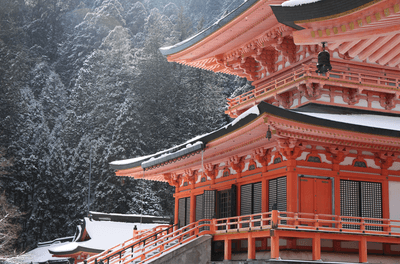


What happens to the mind of a monk who chooses 12 years of isolation? Scientific literature has plenty to say on the matter, and some of it may surprise you.
Sogaku Taguchi, a 31-year-old Tendai Buddhist monk, has started a 12-year period of total seclusion at the Enryaku-ji temple complex on Mount Hiei, overlooking the city of Kyoto in Japan.
12 years of solitude
Starting on September 11, Taguchi severed all contact with the outside world and began a strict daily regimen of preparing simple meals and caring for the mausoleum and its garden. The relentless routine will continue until 2036.
Taguchi is doing this to fulfill the Tendai Buddhist role of a Jishin, which typically translates as “true watcher”. By embarking on this journey, he will become the 118th Jishin since 1699, when records began.
The regime has been described as “hellish” and one of the toughest ascetic training programmes out there. Along with the isolation and merciless routines, monks must also face extremely harsh winters in the mountains with little protection. It’s said that many people have died of illness while attempting to complete the feat.
This might not sound like your idea of a good time, yet Taguchi suggests he is thoroughly looking forward to the experience.
“A desire to live according to the teachings of Dengyodaishi, [a title bestowed by the then emperor], has grown in my heart, and I have walked the path of a monk with that as my goal,” said Taguchi, according to the Japanese newspaper The Yomiuri Shimbun.
“This is one of the ascetic practices asked of us by Dengyodaishi, and I am overflowing with joy to stand at its starting line,” he added.
The science of social isolation
This kind of optimistic excitement is not necessarily what science would predict.
It’s no secret that extreme social isolation can have a dire impact on people psychologically and even harm their physical health. People who endure long periods of loneliness have a higher risk of heart disease, stroke, type 2 diabetes, depression, and anxiety, and, as a result, tend to die earlier.
Research on lonesome researchers in Antarctica, astronauts in space, and prisoners in solitary confinement has vividly shown how intense seclusion can damage well-being in otherwise healthy people.
And in even more extreme situations, there can be dramatic consequences. A long reel of evidence shows that intense isolation from human contact can sometimes trigger psychotic symptoms such as hallucinations, delusions, and confused thoughts.
Between 2009 and 2010, an American woman named Sarah Shourd was held in solitary confinement at a notorious Iranian prison for nearly 14 months after being accused of espionage. Her account of this gruelling experience is truly terrifying.
“In the periphery of my vision, I began to see flashing lights, only to jerk my head around to find that nothing was there,” she wrote in the New York Times in 2011.
“At one point, I heard someone screaming, and it wasn’t until I felt the hands of one of the friendlier guards on my face, trying to revive me, that I realised the screams were my own,” she added.
Positives of purposeful isolation
However, the story of Taguchi and his 12-year period of seclusion on Mount Hiei is very different. He’s doing it out of free will with a very specific purpose for something he deeply believes in.
Research on this distinction is scant, but one useful comparison is a 2017 study in the journal Mental Health, Religion & Culture. Research. Two psychiatrists from UCL traveled to Spain to interview 10 Augustinian nuns and 10 Cistercian monks about solitude and loneliness, revealing some fascinating insights.
The participants did not necessarily see their loneliness as a negative experience, but as a channel to communicate with God. They did describe some real suffering at times, but they also found true meaning in it.
“The monks and nuns tried hard to discipline themselves to endure human solitude, as they considered it an essential requirement to achieve a more intimate relationship with God. Solitude was seen as the necessary condition – an unavoidable prerequisite – to achieving spiritual closeness with God,” the paper reads.
“Therefore, solitude was valued, cherished, sought after and considered worthwhile, as it brought closer what they longed for most: perfect closeness with God,” it added.
The authors suggest that meaning changes how isolation is experienced. Chosen, intentional solitude can be tolerable, perhaps even beneficial, while enforced loneliness is typically harmful.
“Your ego has to die”
One of the monks interviewed in the study, Brother Xavier, had even spent some time with Buddhists and offered some knowledge on what might drive spiritual devotees of all kinds towards a life of seclusion.
“They [Buddhist monks] spent a whole week in a cave, alone, with only water, a week of meditation … it is very hard, because you need to let go, to let go of everything … as you see we have many similarities with them ... we don’t live in a cave, but the finality is very similar, very similar,” Brother Xavier told the researchers.
“The caves that are here are ancient Neolithic tombs and they have the added symbolism of being tombs, because when you enter in one of these caves, you are experiencing a kind of death, your ego has to die.”
Christianity and Buddhism are very different religions, and Taguchi's isolation is far more radical than that of these nuns and monks in a Spanish monastery. However, the study offers a useful lens for understanding what he has undertaken and why his choice is not as masochistic as you might first assume.

 1
1