


 Culture and Society
 PUBLISHED


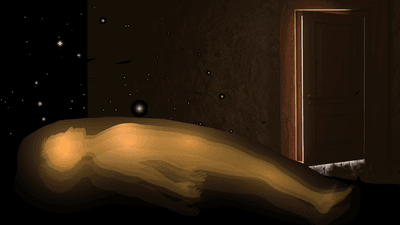


Have you ever met somebody who claims to have had an out-of-body experience? It wouldn’t be surprising. Around 10 to 20 percent of the population are thought to have experienced the sensation of leaving one’s body.
The causes and triggers are varied, but for a rarer few an out-of-body experience can be brought about on purpose. A bold claim, which scientists put to the test in a recent study that yielded one hell of a plot twist.
The participants were given an unusual challenge: identify an image being displayed in another room. Something that would typically be impossible, unless, of course, you can leave your body and travel around through some kind of alternate reality.
Of the 21 participants, 10 reported having an out-of-body experience and 13 had a go at stating what the images were. Those who didn’t experience leaving their bodies said the images came to them internally.
Alas, the results revealed that their responses were no more accurate than guesses, but then something really weird happened. In interviews following the investigations, two participants gave details about the researchers’ locations and activities during the study.
Participant seven stated that during her out-of-body experience she could see the experimenters in the next room and accurately described the way in which they were sitting, with one focused on the computer screen while the other read a book. Participant 13 described, accurately, the way in which one experimenter was taking notes while the other sat to the left of the computer screen.
Their accounts, while pretty freaky, weren’t a part of the original study and so can’t be considered evidence that out-of-body experiences grant a person supernatural insight. However, the researchers say it opens up interesting questions about the future of consciousness research.
“I hope these findings encourage us to think more deeply about what they might mean for our understanding of consciousness and, ultimately, the nature of reality,” said University of Virginia School of Medicine researcher Dr Marina Weiler in a release.
“At its deepest level, this research is not only asking whether out-of-body experiences are real. It is asking what we mean by ‘real’ in the first place.”
Weiler and colleagues suggest that future research could prioritize more memorable, distinctive, or emotionally engaging targets in a similar experimental design. Specific items of clothing or colors could be worn by out-of-view researchers and, should a participant recall a detail like that unprompted, it could make for an exciting day in the lab.
“The unexpected findings give us a potentially useful new direction, but they also need to be tested prospectively and under rigorous conditions before we can know what they mean,” said Weiler.
“For me, the most important takeaway is that unexpected findings can sometimes help us ask better questions. We now have a specific idea that can be tested in future experiments, and that is exactly what science should do.”
The study is published in the journal EXPLORE.




 1
1