Space and Physics
 PUBLISHED


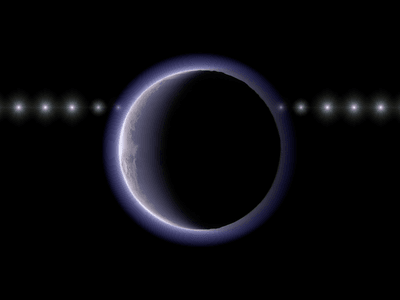


All the worlds discovered beyond the orbit of Neptune so far, the so-called trans-Neptunian objects (TNOs), are cold and small. Only the most famous of them, dwarf planet Pluto, has been seen to be able to retain an atmosphere. For all the others, especially the smaller ones, it was considered to be an impossibility. Unfortunately, someone forgot to tell 2002 XV93.
This TNO is about 500 kilometers (311 miles) across. It is not expected to be able to maintain and hold on to an atmosphere. And yet, observations of this body from 2024 have revealed that an atmosphere appears to be present, challenging what astronomers thought possible in the far reaches of the Solar System.
If you were in Japan on January 10, 2024, then you could have seen 2002 XV93 pass in front of a dim star discovered by the Gaia observatory. Several professional observatories in Kyoto and Nagao Prefectures, as well as a citizen astronomer in Fukushima, observed the stellar occultation. An airless body is expected to abruptly block the light of the distant star; a world with an atmosphere would instead gradually dim it.
In several observations of this encounter, researchers report seeing this gradual drop. This suggests the presence of a thin layer of atmosphere, somewhere between 5 and 10 million times thinner than Earth’s own. It is certainly sparse and rarefied, but it is something. Europa, the icy moon of Jupiter, has a tenuous exosphere, and it is about 200 to 100 times thinner than this distant icy world.
So how can this little world possess an atmosphere? It is currently uncertain. One possibility is that there are internal processes that have led to the formation of cryovolcanoes. It is also possible that the atmosphere is not a long-term feature of this world but a short-term one. It could have been the product of an impact with a comet that liberated gas in the collision.
The finding suggests that it is possible that other TNOs might sport thin atmospheres. The hunt is certainly on. And researchers expect that future stellar occultations and observations using space telescopes might reveal more insights into this world’s atmosphere and its evolution.
2002 XV93 goes around the Sun twice for every three revolutions of Neptune. A single orbit takes 247.47 years. At its closest distance, it is 34 times farther from the Sun than Earth is.
The study is published in the journal Nature Astronomy.