Space and Physics
 PUBLISHED



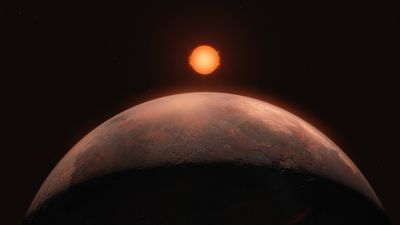


Astronomers have found a planet around Barnard’s star, the closest single star to the Sun. It is the fourth closest star overall, after the three stars in the Alpha Centauri system, which already have planets around Proxima Centauri. Still, this new world is very exciting.
It is estimated to be half the mass of Venus, making it one of the few exoplanets smaller than Earth. There will of course be plenty of other small planets – it’s just difficult to see them. There was a tentative detection around Barnard’s star in 2018, but it took many years of observation with the European Southern Observatory’s Very Large Telescope to find this faint signal, even from a star that is relatively next door to us.
“Even if it took a long time, we were always confident that we could find something,” lead author Jonay González Hernández, a researcher at the Instituto de Astrofísica de Canarias in Spain, said in a statement.
The team conducted observations to hopefully find a planet in the habitable zone of this star. Being a red dwarf and so cooler than our Sun, the habitable zone is much closer. However, the new planet Barnard b is a little bit too close, orbiting the star every 3.15 Earth days. It is estimated to have a surface temperature of 125 °C (257 °F), a bit too hot for the habitable zone requirements.
“Barnard b is one of the lowest-mass exoplanets known and one of the few known with a mass less than that of Earth. But the planet is too close to the host star, closer than the habitable zone,” explained González Hernández. “Even if the star is about 2500 degrees cooler than our Sun, it is too hot there to maintain liquid water on the surface.”
Still, there’s hope for more planets around this star. There have been more tentative detections but the team is not yet ready to call them discoveries. Barnard’s star is too dim to be seen with the naked eye despite its closeness, and planets are a lot more difficult to discover.
“We now need to continue observing this star to confirm the other candidate signals,” added Alejandro Suárez Mascareño, also a researcher at the Instituto de Astrofísica de Canarias and co-author of the study. “But the discovery of this planet, along with other previous discoveries such as Proxima b and d, shows that our cosmic backyard is full of low-mass planets.”
The study is published in Astronomy & Astrophysics.