Space and Physics
 PUBLISHED



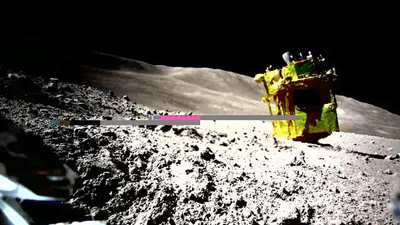


Almost a year since its launch and eight months since landing on the Moon, Japan's SLIM (Smart Lander for Investigating Moon) mission is officially over. The Japanese Space Agency (JAXA) confirmed the decision in a press statement on August 26. SLIM was last heard from in late April but survived much longer than its intended mission, overcoming difficulties.
SLIM landed on January 20, 2024, making Japan the fifth nation to successfully soft-land on the Moon. Its precision landing was history-making but it immediately experienced problems; the spacecraft landed slanted at an angle that greatly reduced the amount of sunlight available, leaving it to immediately run on batteries, not solar power as planned. The scientific mission had to be readjusted but it went on to go above and beyond its initial mission over the next few months.
Its main goal was achieved at touchdown, though. The mission was set to demonstrate that it is possible to land on another celestial body with incredible precision. Its landing ellipse was 100 meters (330 feet) from a specific pinpointed area. For comparison, Apollo 11 had an ellipse of approximately 20 kilometers by 5 kilometers (12 by 3.1 miles). SLIM did even better than expected.
“The landing precision was evaluated with a position error of approximately 10 meters from the target point, confirming the world's first successful pinpoint landing," JAXA wrote in a statement. "In addition, the Multi-Band Camera (MBC) successfully performed spectral observations in 10 wavelength bands on 10 rocks, exceeding initial expectations. Further, despite not being part of the original mission plan, the spacecraft was confirmed to survive three lunar nights and remained operational, demonstrating results that surpassed initial goals."
The last communication JAXA had from SLIM was on April 28. Over the last four months, numerous attempts have been made to re-establish contact with the lander. Unfortunately, none of them were successful. Still, cool science has been conducted even without a response from the craft.
NASA tested the Laser Retroreflector Array on the mission and used its Lunar Reconnaissance Orbiter (LRO) to shoot a laser at the spacecraft. This approach might be useful in the future to precisely locate objects or facilities on the Moon and provide a location for a super precise landing, as SLIM has demonstrated.
“We extend our deepest gratitude to all parties involved in the development and operation of SLIM for their cooperation and support, as well as all those who encouraged the mission,” JAXA said.
A full report on the scientific contributions of SLIM and its tiny robotic rovers will be published in the near future.