Space and Physics
 PUBLISHED



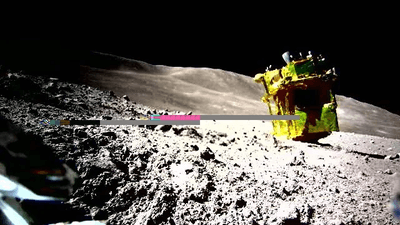


There is no GPS on the Moon – so to find where things land and go, we have to rely on orbital observations. To make this work easier, NASA has developed an ingenious object that doesn’t require power to make its presence known: You put it on top of your lander and you are ready to be found, then you wait for NASA’s Lunar Reconnaissance Orbiter (LRO) to shoot a laser at you. It worked for the Vikram rover, and has now worked for Smart Lander for Investigating Moon (SLIM) too.
SLIM is a Japanese Aerospace Exploration Agency lander, and Vikram is a mission from the Indian Space Research Organisation. With these landers, the Asian nations became the fourth and fifth countries to land on the Moon. NASA Laser Retroreflector Arrays have hitched a ride on both of them so they can be tested out.
The device on SLIM is the size of a cookie, 5 centimeters (2 inches) across. It has eight quartz corner-cube prisms set into a dome-shaped aluminum frame. Thanks to those, it can reflect light coming from multiple directions. LRO can use its laser altimeter to hit it and record the light that bounces back.
“LRO’s altimeter wasn’t built for this type of application, so the chances of pinpointing a tiny retroreflector on the Moon’s surface are already low,” Xiaoli Sun, who led the team that built SLIM’s retroreflector at NASA’s Goddard Space Flight Center as part of a partnership between NASA and JAXA, said in a statement.
But there was a complication: SLIM landed on its side, so it wasn’t easy to actually get a ping from the retroreflector. The first eight attempts led to nothing. It was only the ninth and tenth attempts that resulted in a signal back. It took multiple attempts for Vikram as well, but there, the team didn’t have to make sure they knew exactly where the location of the lander was. To confirm the signal was from SLIM, that was necessary.
Still, it shows that the system works – even in unexpected conditions. A future system of positioning involving the retroreflectors would have an orbital partner actually designed to do such a job. LRO’s altimeter is not bespoke. So the fact that the system works even at an angle is great.
“For the LRO team to have reached a retroreflector that faces sideways, instead of the sky, shows that these little devices are incredibly resilient,” Sun added.
The system could be used in future crewed and uncrewed missions to land closer to other spacecraft or objects already on the surface of the Moon.