Space and Physics
 PUBLISHED
 12
12



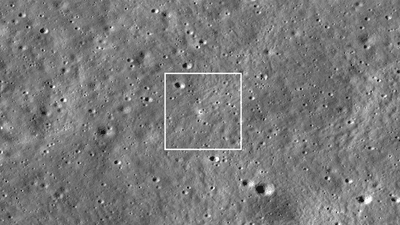


NASA’s Lunar Reconnaissance Orbiter successfully shot a laser toward India's Vikram lander on the Moon. However, this was not the first shot in a new space war but a carefully planned scientific experiment. The laser traveled about 100 kilometers (62 miles) from orbit to the surface of the Moon, hitting a target just 5 centimeters (2 inches) wide. It was the first time a laser was shot from around the Moon to a target on its surface.
The tiny Oreo-sized target, a Laser Retroreflector Array, was placed on the Indian Space Research Organization (ISRO)’s Vikram lander. The laser bounced off the target and was picked up again by NASA as it whizzed around the Moon. Bouncing light to and from satellites is used on Earth to know where they are in their orbit. On the Moon, this approach could be used to determine the precise location of a stationary object.
“We’ve shown that we can locate our retroreflector on the surface from the Moon’s orbit,” mission leader Xiaoli Sun, from NASA’s Goddard Space Flight Center, said in a statement. “The next step is to improve the technique so that it can become routine for missions that want to use these retroreflectors in the future.”

Xiaoli Sun’s team developed the retroreflector on Vikram as part of a partnership between NASA and ISRO. The device can reflect light coming from any direction. It is also completely optical, so it doesn’t require power or maintenance. This means they could keep finding the precise location of Vikram over and over again for decades to come. Vikram is no longer functional so it's not actually going anywhere, but future missions will move on the Moon, and knowing where they are will be important.
Surprisingly the difficulty was not the target. Retroreflectors on the Moon about the size of a suitcase have been used since the Apollo era. Thanks to those we know that the Moon is moving away from us by 3.8 centimeters (1.5 inches) every year. NASA used the only laser instrument around the Moon right now, the Lunar Orbiter's altimeter, LOLA. LOLA, which has been working 13 years beyond its primary mission so far, was not designed to hit such a small target, usually aiming for an area 10 meters wide.
“We would like LOLA to point to this Oreo-sized target and hit it every time, which is hard,” said Daniel Cremons, a NASA Goddard scientist who works with Sun.
It took LOLA eight goes to hit the Vikram retroreflector but if LOLA can do it, specialized future lasers could easily make retroreflectors a crucial technology for future lunar missions. NASA also has a retroreflector on Japan's SLIM, which landed on the Moon on Friday. We shall see if LOLA can repeat the same impressive feat again.