Health and Medicine
 PUBLISHED
 1
1





Aging brings with it many challenges and uncertainties when it comes to our health. But one of the more troublesome, both in terms of how little we understand it as well as the impacts it has on a person’s selfhood, is Alzheimer’s disease.
This neurodegenerative condition affects the brain and is the most common cause of dementia (accounting for between 60-80 percent of cases), damaging a person’s memory, thinking, and ability to function over time.
It is estimated that around 7.4 million Americans aged 65 and older are currently living with the disease, and this number is rising. This is due to a combination of factors.
As the global population continues to age and people live for longer, there are more individuals living into the age groups most at risk. There have also been significant developments in diagnostic techniques that make it easier to identify patients who would have previously been overlooked.
But while much of what we understand about Alzheimer’s disease comes from a wide range of disciplines, from molecular neuroscience to large epidemiological studies, there is one study that occupies a special place in our search for understanding: the Nun Study.
This is pretty much what it says on the tin – a study into Alzheimer’s disease based on a population of nuns in the United States. It may sound comical, but it has offered insights that have changed how we think about the disease, shifting it away from one focused only on brain pathology, to a complex interaction between brain health and lifestyle factors.
The start of a decades-long journey
In 1986, a young assistant professor in epidemiology, David A. Snowdon, was looking for his research niche. To this point, he had specialized in studying illnesses among populations of religious groups, but now he wanted to turn his attention to aging.
In particular, Snowdon had observed that the life expectancy of a child born at the time of writing was 75 years, while for those who had been born at the beginning of the century it was only 47 years. This significant increase brought with it concerns. As more people reached older age, there would be an increase in age-related illnesses, but to what extent? What proportion of people who made it to advanced age would experience age-related decline and how many would not?
Snowdon wanted to find out. In particular, he wanted to investigate the best ways to maintain “health and function” in old age.
Enter the nuns. Snowdon started a pilot study with the School Sisters of Notre Dame, an international institute of Roman Catholic nuns, in Mankato, Minnesota. There were 366 sisters at this particular “province” – the name given to regional communities of these nuns across the world – and they had all joined the sisterhood during their early 20s. Of these sisters, 306 were suitable for Snowdon’s research into old age – they were all aged 75 or over and had served as nuns for over 50 years.
In his analysis, Snowdon examined the relationship between the level of education the sisters had achieved when younger, as well as their overall health and independence in their old age. He found that those sisters who had obtained a bachelor’s degree or higher were more likely to survive to old age while also maintaining their ability to look after themselves, when compared to those who only went to grade school.
While these results were not necessarily groundbreaking, Snowdon’s study was methodologically valuable. In essence, the sisters were an ideal control group who had spent most of their adult lives in the same environment. This offered a rare opportunity to focus on how lifestyle factors influenced late-life physical and cognitive functioning.
Such a group of individuals was a rare treasure trove of data that was free of the types of problems that affect epidemiological research of other, more diverse groups.
To be sure, this was not the first time nuns had contributed to scientific research. During the 1950s and 60s, they provided critical information related to breast cancer and cervical cancer.
For instance, in 1969, researchers found that breast cancer rates were surprisingly high among nuns as well as other single women. The cause they identified was the absence of pregnancy and the hormonal changes it brings with it. Although often overly generalized, framing pregnancy as directly protective without knowing the underlying biological mechanisms, later research has replicated this correlation (though in a far more nuanced way).
Snowdon’s study differed from these earlier efforts in its scope and duration. With the sisters’ personal biographies, as well as archive records, he was able to assess decades of information, linking early life to late-life outcomes. His success allowed him to create the Nun Study a decade later.
This expanded longitudinal study examined aging and the incidence of Alzheimer’s disease among 678 sisters from the same School across the US. At the start of the study, all the sisters who participated were between the ages of 75 and 102, and all had similar backgrounds.
As with the pilot research, their communal living conditions offered all the sisters the similar housing, income, diets, and access to healthcare. They also all had similar reproductive histories, networks, smoking histories, and alcohol intake.
To say the sisters were generous is an understatement. They not only agreed to participate in neuropsychological tests and offered access to their personal records, but they also gave the researchers their brains. This latter donation was a prerequisite of the study, allowing Snowdon and subsequent generations of researchers to carry out over 600 brain autopsies over the next three decades.
Writing in 2001, Snowdon explained, “For nearly fifteen years now, the Nun Study has led me deeper and deeper into a world of aging and Alzheimer’s, the questions becoming even more layered and intriguing, the possible answers more meaningful to all of us.”
“What my coworkers and I have learned so far has challenged some of the basic scientific tenets about Alzheimer’s disease, which afflicts up to 45 percent of Americans over eighty-five years of age. Aging may be inevitable, but as our research shows, Alzheimer’s disease may not be – and we have uncovered promising clues about how to avoid it.”
30 years of progress
Since these early days, the Nun Study has helped shape our understanding of this degenerative disease, and the work is ongoing. Although none of the sisters in the study are still alive, their data continues to offer insights into the neuropathology associated with aging.
In 2025, a paper analyzing the Nun Study’s 30 years of progress was published by scientists at the University of Texas Health Science Center at San Antonio, where the research is now housed. The study offers a great summary of the key findings from this unique and exemplary work.
As with Snowdon’s research in 1986, the early findings showed a link between education and the risk of cognitive decline in later life. Sisters with bachelor’s degrees or higher showed less decline between the first two assessment periods than those without these attainments. The risk of developing dementia was also increased with age for those with grade school education only.
Early-life language skills also appeared to be a factor for later decline. Analysis of the autobiographies written by the nuns during their early adulthood suggests that the foundations for brain health may be set early in life.
There is of course a genetic factor here too. Sisters carrying a specific genetic variant (APOE ε4) were more likely to develop dementia, while those without stayed healthier more regularly.
The researchers also defined a stage known as mild cognitive impairment (MCI) – a stage between the expected cognitive decline of a normal aging and the more troublesome decline into dementia. People in this category experience problems with their memory, language, and thinking, but are not so impaired that it interferes with their daily lives.
This finding shows that some people go on to develop dementia, but others remain stable or can even improve.
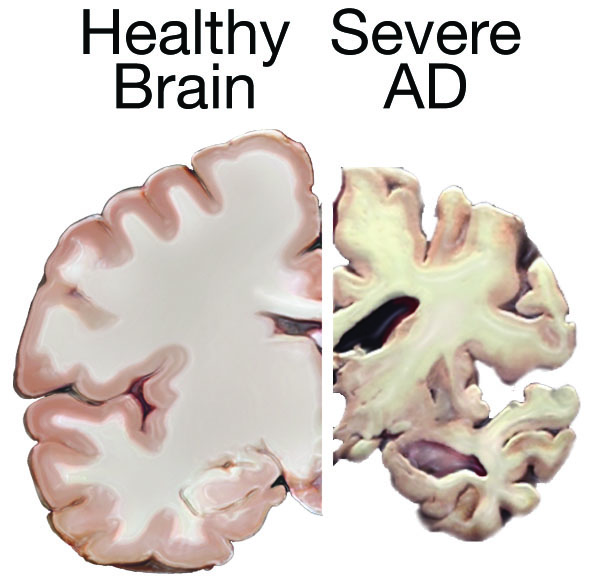
When it comes to physical changes in the brain, the Nun Study shows that there is a build-up of abnormal proteins in the brain, as well as shrinkage in the hippocampus, which are strongly linked to cognitive decline. But it also demonstrated that this relationship is complex. Some nuns showed clear signs of Alzheimer’s disease in their brains but were otherwise functioning completely typically during their daily life.
This suggests there is a form of “cognitive resilience” in some people.
Brain structure, especially the size of the hippocampus, could also be an early indicator of future memory problems. However, it also reveals that dementia is not caused by Alzheimer’s pathology in the brain alone. Small strokes and damage to blood vessels combined with Alzheimer's seems to worsen decline.
In addition, other age-related change to the brain, such as hippocampal sclerosis – a neurological condition that involves the loss of neurons and scarring in the hippocampus – and changes to TDP-3 protein – which regulates vital cellular processes – also contribute to memory loss.
The Nun study has offered unprecedented insights into how Alzheimer’s disease develops and the various age-related factors that either contribute to its rise or may mitigate it. The research continues because of the incredible generosity of the nuns of the School Sisters of Notre Dame, but there is more to do.
Age-related decline is increasing across the world, a situation that is preventing too many people from aging with grace.