Nature
 PUBLISHED



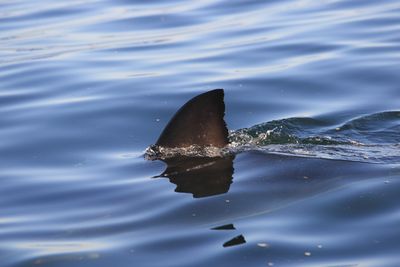


Whenever you see a street-swimming shark doing the rounds on social media, it pays to be skeptical. This time, however, you can rest assured it's the real deal.
Last weekend, a shark was spotted swimming down a residential street after flooding hit Surf City, a borough on Long Beach Island, Ocean County, New Jersey.
“Is that a little shark? Oh my god,” a person can be heard saying in the footage. “He’s coming this way,” they added.
But fear not; this wasn't a Jaws-like villain prowling around town for human prey. The animal was most likely a dusky smooth-hound (Mustelus canis), also called a smooth dogfish or dog shark, which average only 120 centimeters (42 inches) in length and pose no threat to humans.
If this type of shark wanted to take a chomp out of you, it wouldn’t be too catastrophic. The species possesses low, flattened teeth that are better adapted for crushing the shells of crustaceans, rather than tearing through flesh.
Nor’easter flooding
The shark ended up in the residential neighborhood after the East Coast of the US was struck by a nor'easter in late September. Nor'easters are extratropical cyclones named for the typical direction of their winds. They form in the western North Atlantic, bringing strong winds, heavy rain, and coastal flooding to this part of North America.
When strong storms like this push seawater over the shore and into low-lying areas, marine creatures can easily be swept along with the waves. Coastal towns on thin barrier islands, like Long Beach Island, can be especially vulnerable to this kind of flooding.
The September 2026 nor'easter was unusually strong and early in the season. At time of writing, it's reported that 200,000 people were left without power and over 550 flights were cancelled. There was also one casualty, a 56-year-old New Jersey resident who was killed by a falling tree.
Twelve days of terror in 1916
Compared with all that, this harmless dogfish clearly wasn't causing any problems. But New Jersey isn’t a total stranger to shark attacks.
Between July 1 and 12 in 1916, the Jersey Shore was ravaged by a series of five shark attacks, in which four people died and another was seriously injured.
Fairly understandably, the spate of fatal shark attacks sparked panic as it was assumed they didn’t occur in temperate waters. Beach resorts lost much of their summer business, and officials hired hunters and offered bounties to find the culprit.
It wasn't just a coastal problem. In one of the incidents, an 11-year-old boy named Lester Stillwell was fatally injured by a shark while playing in a creek, some 25 kilometers (16 miles) inland.
Why these “twelve days of terror” occurred is a bit of a mystery. Some believe the attacks were the work of a single rogue shark with an especially bad temper, although this has never been definitively proven.
The bizarre events left a lasting mark on American pop culture. It probably wasn't the inspiration behind Peter Benchley's novel-turned-movie Jaws, despite what you might have heard, but it may have influenced the 1916 presidential election.

 1
1