Culture and Society
 PUBLISHED
 2
2





It’s an oft-repeated statement that sharks’ reputation as bloodthirsty maneaters is a trope based not in fact, but on the 1975 blockbuster movie Jaws. Like so many famous “facts”, however, this isn't entirely true.
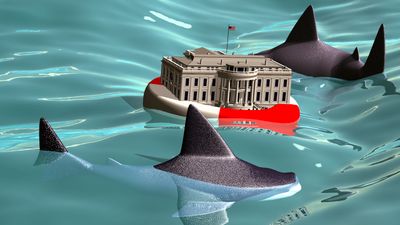
No, we’re not about to tell you that, obviously, we’ve always thought sharks were dangerous (look at all those teeth, after all!). The truth is actually weirder: it goes back specifically to 1916 – and, legend has it, nearly cost Woodrow Wilson his presidency.
The jaws that inspired Jaws
Nineteen-sixteen was a hell of a year. Polio was running rampant through New York; Europe was halfway through the bloodiest war the planet had ever seen (and the US seemed doomed to soon join it); and to top it all off, you couldn’t even see a real-life passenger pigeon anymore, since the last one had died two years previously.
And, in New Jersey, sharks were on the attack.
“SHARK KILLS BATHER OFF JERSEY BEACH” announced the July 7 edition of The New York Times after a swimmer off the coast of Spring Lake, New Jersey, had both his legs bitten off and died awaiting medical attention. It was the second such attack in the area that week, and it wouldn’t be the last: five days later, in Matawan Creek, two more people were killed by a stray shark that had somehow made it 2.5 kilometers inland for a snack. One victim was just 11 years old.
The last attack, and the only non-fatal one, came quickly after that: a 14-year-old boy named Joseph Dunn, who lost much of his left leg and would later say he could even feel it going down the shark’s throat. He survived, but the damage to the national psyche was done: Matawan Creek was dynamited; locals patrolled the coasts with shotguns, and gangs of fishermen drove loud motorboats through the water armed with nets to catch any sharks not scared away by the noise.
The public was in a panic. To give an idea of how dramatic the impact of the shark spree was, consider this: just three months prior to the first attack, “a group of scientists from the American Museum assembled a scientific paper, saying with finality that shark attacks against man north of Cape Hatteras (North Carolina) do not happen”, Richard G. Fernicola, a historian and author of Twelve Days of Terror: A Definitive Investigation of the 1916 New Jersey Shark Attacks, told Asbury Park Press in 2016.
Sharks, in fact, weren't considered all that dangerous. Sure, people might steer clear if they saw one in the water, but it was generally the consensus that no shark had ever attacked a human unprovoked, and probably no shark ever would. “Over and over, members of the scientific community would view the threat of a shark attack, at least in nontropical waters, a nonissue,” Fernicola wrote.
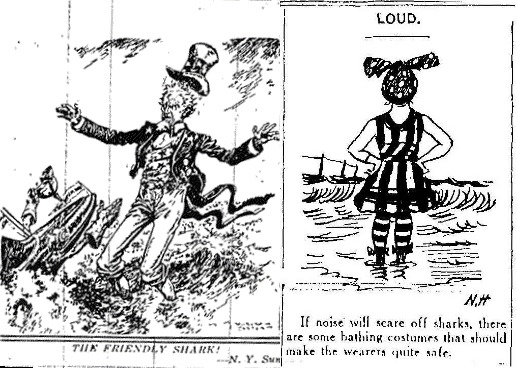
After the summer of 1916, however, the public had a new nemesis. Sensational headlines told of how the “maneater” was still at large. Cartoonists started using sharks as a shorthand for evil – they embodied diseases; unpopular politicians; even German U-boats were given fins and teeth in the national press as they swam up to bite at Uncle Sam’s ankles. The number of beachgoers plummeted by three-quarters in some areas; resort towns lost millions of dollars of expected income even as they pled with newspaper writers to tone down the coverage.
“The day Bruder [the unfortunate swimmer at Spring Lake] was killed, 24 people died in New York City of polio, then called infantile paralysis,” wrote Thomas B. Allen in his 1996 book Shadows in the Sea: The Sharks, Skates, and Rays. “Bruder’s death received far larger coverage in the New York papers. Such is the glamour and the terror of the shark!”
Blood in the water
In the wake of the attacks, President Wilson was moved to action. At the urging of the Secretary of the Treasury, he authorized the deployment of the US Coast Guard and the National Marine Fisheries Service to fend off the supposed shark menace, and an emergency meeting of the Cabinet was scheduled to discuss what was fast becoming a crisis in the public imagination.
An overreaction? Perhaps. But there are signs Wilson may have been right to worry.
“Every indication in the New Jersey vote returns is that the horrifying shark attacks during the summer of 1916 reduced Wilson’s vote in the beach communities by about ten percentage points,” concluded political scientists Christopher Achen and Larry Bartels in a now-infamous 2002 paper titled Blind Retrospection: Why Shark Attacks Are Bad For Democracy.
“An effect of that size may sound modest to those unfamiliar with American electoral experience, but by those standards it is a near-earthquake,” they wrote. “A full earthquake, Franklin Roosevelt’s landslide victory in the 1932 election during the Great Depression, reduced Hoover’s vote in New Jersey by just twelve percentage points.”
It was a big swing – but could it really be attributed, even in part, to the shark attacks? After all, as Achen and Bartels themselves acknowledge, “no government has any influence over sharks”. But their numbers seem convincing: between 1912 and 1916, they found Wilson to have lost a massive 13.3 percentage points in beach counties – nearly 27 times as big a drop as in communities further inland.
How can such a sea change be explained? Well, this is where things get controversial: until Achen and Bartels’s work, voters were generally considered to be, if not well-informed, then at least rational. The prevailing model was of “retrospective voting”, in which voters would reward or punish incumbent leaders with their votes based on whether their governance has improved their own welfare – essentially, voting based on the answer to the question “am I better off than I was four years ago?”
But with the summer of 1916, Achen and Bartels believed something else was at play. “The attacks caused several deaths plus considerable emotional and financial distress to shore communities,” they pointed out, and “the election occurred just a few months after[wards].”
It was undeniable that the voters of the beach communities in New Jersey were hurting, and so – just as retrospective voting predicts – they lashed out at the polls. The retrospection, Achen and Bartels wrote, “was blind”.
“Shark attacks are random events in the purest sense of the term, and they have no governmental solution. If bathers insist on swimming in the ocean, governments then and now cannot save them,” they wrote. In the wake of the 1916 attacks, “vacationers could not be compelled to come to the beach, nor could the sharks be forced to stay away. The government was helpless.”
“Yet the voters punished anyway.”
Or did they?
Biting back
That voters are so irrational as to let sharks dictate the presidency was a big claim at the time – and, unsurprisingly, the paper had some detractors. In 2016, Achen and Bartels’s study was revisited by two other political scientists, Anthony Fowler and Andrew Hall – and their work seemed to refute the previous paper entirely.
Their argument came in a few parts. First, they looked at every other election between 1872 and 2012 and compared them against every recorded fatal shark attack in US history – if shark attacks really do influence election results, they reasoned, surely the effect would be seen in more years than just 1916. But instead, they found… well, nothing. “The resulting estimates are substantively small and statistically null, suggesting that any potential effect of shark attacks on presidential elections is likely modest,” they wrote.
Second, they took issue with the choices Achen and Bartels had made in processing their data. Sure, if you accept the premises of the 2002 paper, then the resulting statistical analysis is correct, they said – but is that setup actually justified? Measuring the vote share in only those counties where the attacks happened, instead of all beach counties, for example, produces a much more modest effect.
Third, they said, it was kind of silly to compare the 1916 election with the 1912 one. While it seems to make sense, on account of their wanting to compare specifically Wilson’s vote share, it doesn’t account for the fact that the 1912 election was pretty wild. Unlike almost every other election in US history, it was a three-way race – former president Teddy Roosevelt ran as the Progressive party candidate (mascot: a moose) and came second – and Wilson cleaned up, collecting 425 of the 531 electoral votes available.
In other words, “1912 is the notable outlier”, Fowler and Hall wrote. “Achen and Bartels’ estimate is most likely explained by the unusualness of 1912 rather than anything that happened in 1916.”
Overall, they concluded, the effect was much smaller than Achen and Bartels had thought – if indeed it existed at all. “There is virtually no compelling evidence that shark attacks influence elections,” they wrote, “and any such effect – if it exists – must be substantively tiny.”
A final twist to the tale
Was Achen and Bartels’s dream of shark-influenced democracy dead? Not quite. Pretty soon, the pair came out with a re-rebuttal paper, arguing that most of the objections weren’t relevant to their original paper and clarifying that they didn’t say shark attacks generally influence elections – only that the ones in 1916 did. Fowler and Hall wrote a re-re-rebuttal, and the whole thing ended fairly amicably as one of political science’s more notable historical digressions.
And so what was the conclusion? Did Jaws really chomp Wilson’s vote share in 1916, or was it all just statistical smoke and mirrors? Truth is, we’ll probably never know.
But probably more important than the results of these papers is the scientific outlook they reveal. Far from being upset by Fowler and Hall’s challenge, Achen and Bartels welcomed it: “We thank Professors Fowler and Hall for their discussion of our work,” they wrote, “[and] we are grateful for the opportunity to address their concerns, clarifying and extending the argument we presented.”
“Broad concerns of the sort raised by Fowler and Hall’s critique of our work are always in order,” they reminded us. “Human beings are always subject to errors and biases, and good science requires both open-mindedness and humility.”