Space and Physics
 PUBLISHED


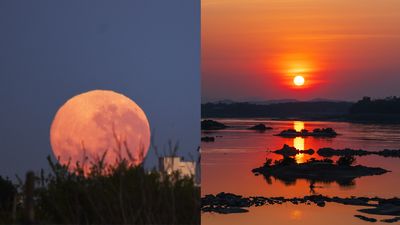


It is pretty important, during an eclipse of any kind, that the Moon and the Sun are on opposite sides of the Earth. The three celestial bodies are in syzygy, a cosmic straight line. You do not get an eclipse otherwise. So, it should be impossible to see the eclipsed Moon and the Sun in the sky at the same time; one of them should be below the horizon. However, thanks to Earth's atmosphere, what should be impossible becomes just a very rare event – one that some lucky people will see tomorrow during the total lunar eclipse.
The phenomenon is known as Selenelion (or selenhelion). People on the East Coast of the United States, Quebec, Southern Mexico, and the rest of Central America, as well as Colombia and Ecuador, will have a chance to see it. The total lunar eclipse will happen as the Moon is setting and the Sun is rising. That gives a brief window where both celestial objects will appear in the sky.
The Moon during a total lunar eclipse appears red because the shadow of the Earth is not black but red. This is because sunlight gets scattered in the atmosphere by wavelength, and longer wavelengths are scattered more, making sunrises, sunsets, and the planet’s shadow a ruby hue. Our atmosphere doesn’t just scatter the Sunlight, it can also refract light as well.
When bright objects like the Sun or the Moon are just below the horizon, our atmosphere creates a mirage, making them look like they are just above it, similar to a perceived shift in size of objects when looking at them through water. It is thanks to this that the Selenelion is possible. The eclipsed Moon will be visible as it is above the horizon, while the rising Sun will just appear to be above the horizon, allowing both to be seen in the sky at the same time, even though they remain at opposite sides of the planet.
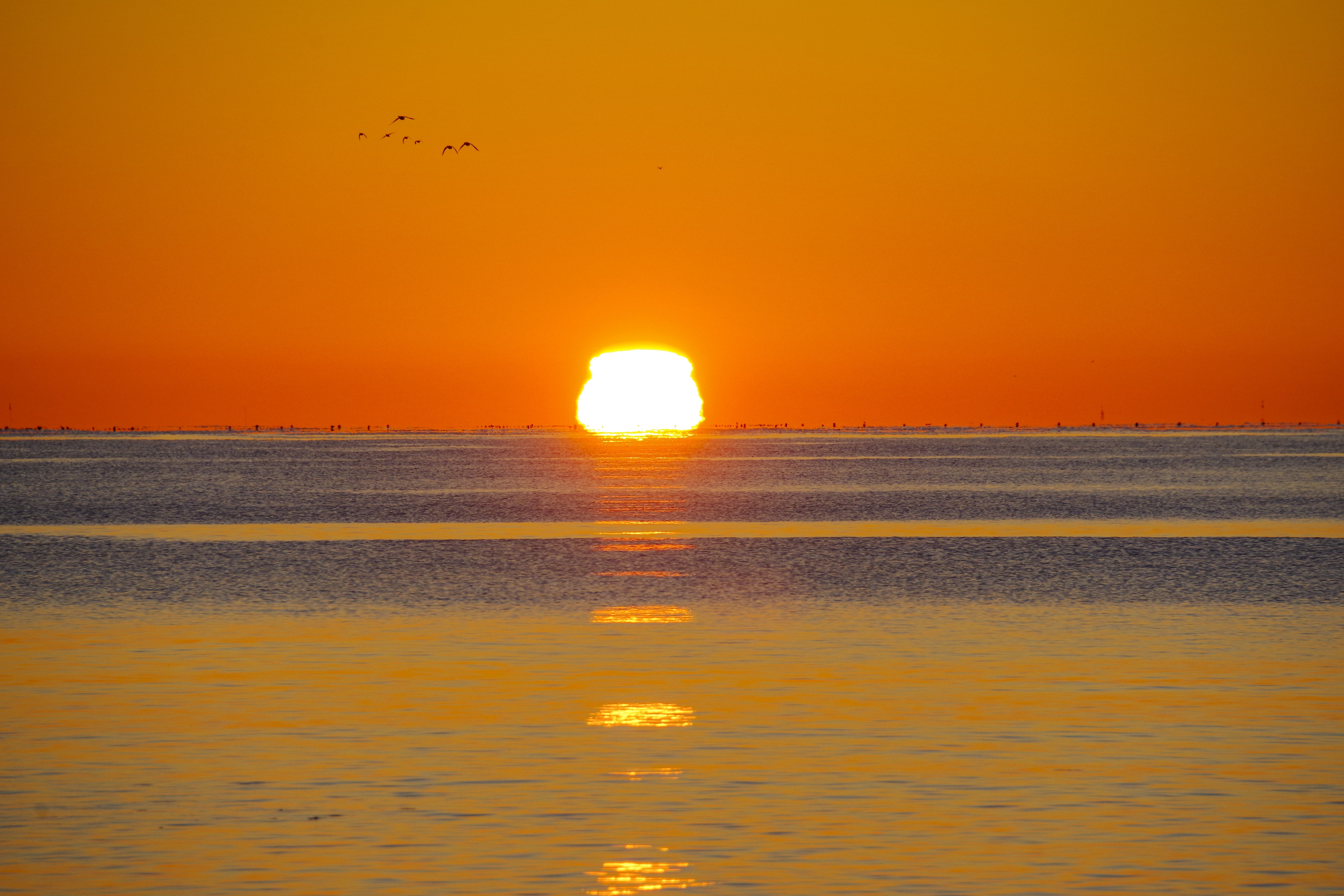
While all the regions listed above will have a chance to see this very peculiar event, you must have clear horizons to the East and to the West, and the whole affair takes place in a matter of minutes. If you have the right conditions, you can check the timings of Moon setting and sunrise on Time & Date.
At least part of the total lunar eclipse will be visible across North America, Oceania, and most of East Asia. If we include partial and penumbral phases will also be visible from Brazil to Central Asia. Eclipses do not happen every Full Moon because the orbit of the Moon is inclined so that syzygy happens less regularly. There are several partial eclipses in the coming years, but the next total one will require some patience: it will be on December 31, 2028.
[H/T: Space.com]